Published by
WestNet First Responders Technology Solutions
medical.westnet.ca Co-published with
WestNet Medical Publications
WestNet Humanitarian Services (WHS)
UN Supplier / NGO • www.westnet.ngo WestNet Catalog 731985456673
ISBN 9798173554574
A WestNet First Responder Field Guide — EMS · Fire · Police · United States & Canada
WestNet First Responders, No. 01 • WestNet Catalog 731985456673 • ISBN 9798173554574
Co-published by WestNet Medical Publications & WestNet Humanitarian Services
First Edition • Last updated: June 2026
Calgary EditionGrounded in Calgary & Alberta context • Applicable across North America
Why This Field Guide Exists
The world a first responder steps into changed after 2020 — more mental-health and social-disorder calls, a deadlier drug supply, thinner crews, and a public that watches every move. This guide is a practical, root-cause companion for that reality: treat the person, not the label; address causes, not just symptoms; and make humans human again — for the people we serve and for the responders who serve them.
WestNet First Responders
Co-published with WestNet Medical Publications & WestNet Humanitarian Services
“Every overdose, every welfare check, every person in crisis is a human being first. The badge, the rig, and the helmet exist to protect people — including the one wearing them. We fix problems at the source: the responder’s own nervous system, the call that keeps repeating, the cause beneath the symptom. That is how you go home whole, and how the public trusts you when you arrive.”
Published By
WestNet First Responders Technology Solutions
A division of WestNet North America Inc. medical.westnet.ca
Co-Published With
WestNet Medical Publications
& WestNet Humanitarian Services (WHS)
UN Supplier • Registered NGO www.westnet.ngo
WestNet Catalog (UPC-A): 7 31985 45667 3
ISBN 9798173554574 • First Edition • Calgary Edition
7 31985 45667 3
WestNet First Responders
Field Guide Information
Info
Field
Detail
Title
Responding in a Post-2020 World — WestNet First Responders No. 01 (Calgary Edition)
Audience
EMS / Paramedics, Firefighters, Police & Peace Officers, Communications (911/dispatch), and allied crisis responders — United States & Canada
Format
Professional continuing-education field guide. Self-paced reader with interactive tools.
Publication
WestNet First Responders • Catalog 731985456673 • ISBN 9798173554574
Disclosure
Professional education only. Does not replace your agency’s policy, the law in your jurisdiction, your medical direction, or scene command. Always verify against current local protocols.
How To Use This Guide
Read it cover to cover, or jump to a section from the menu. The interactive tools are teaching aids — they sharpen judgment, they do not replace it. Wherever this guide describes an action, the rule is the same: verify against your agency’s current policy, local law, and medical direction before you act.
Preface — The Root-Cause Lens
§ 01
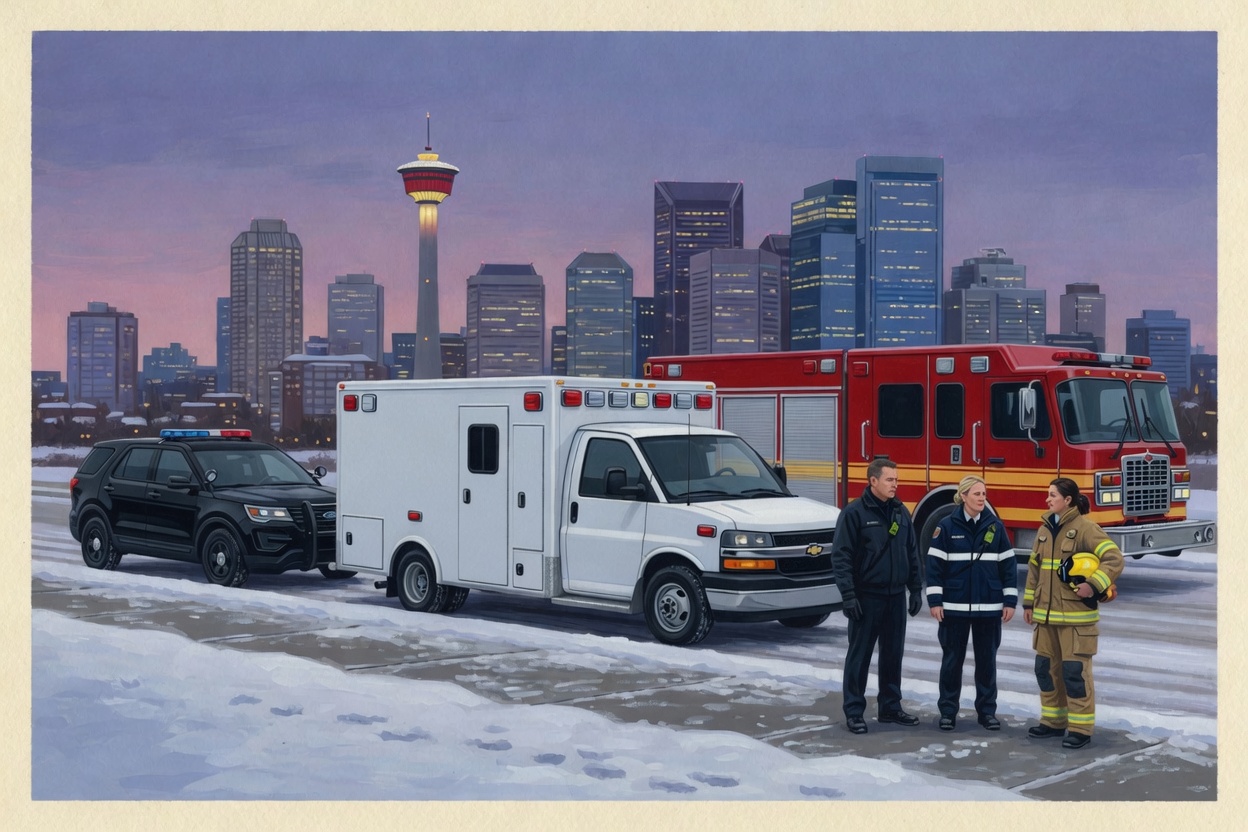
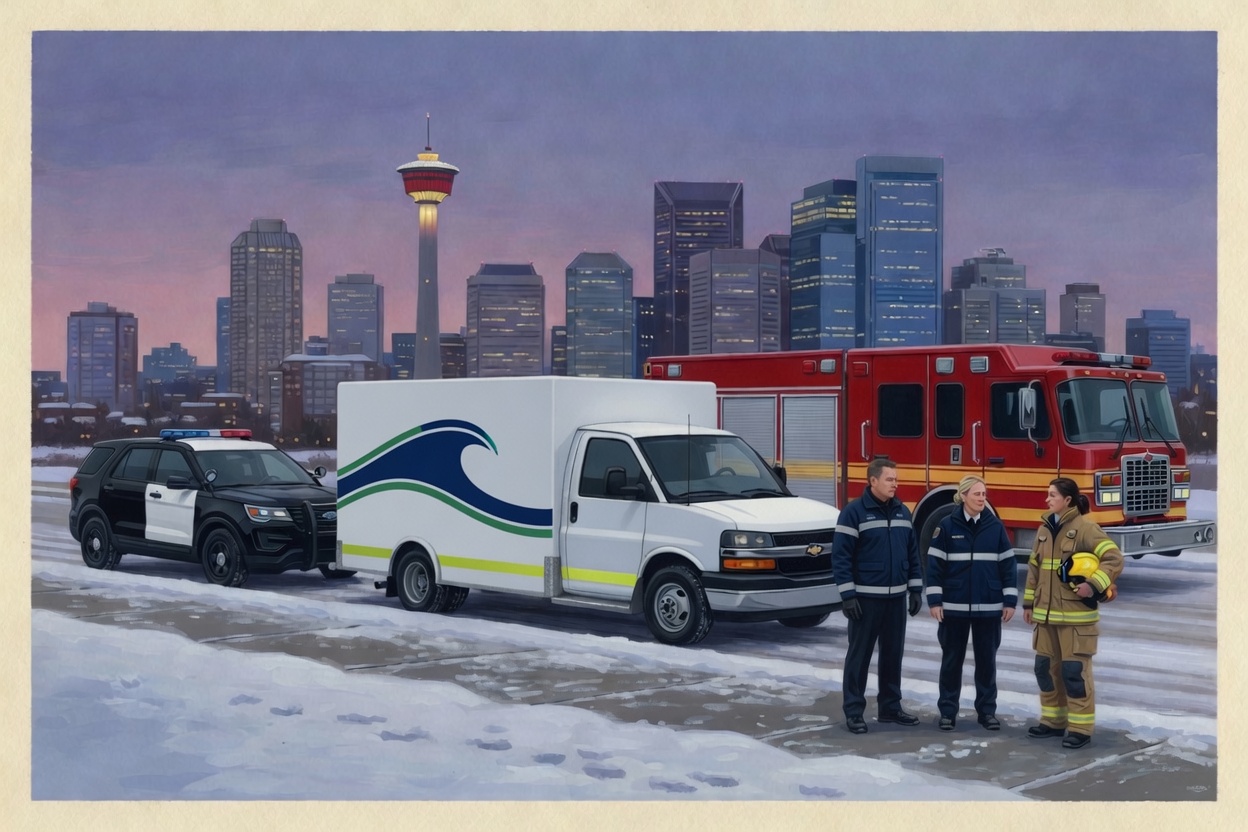
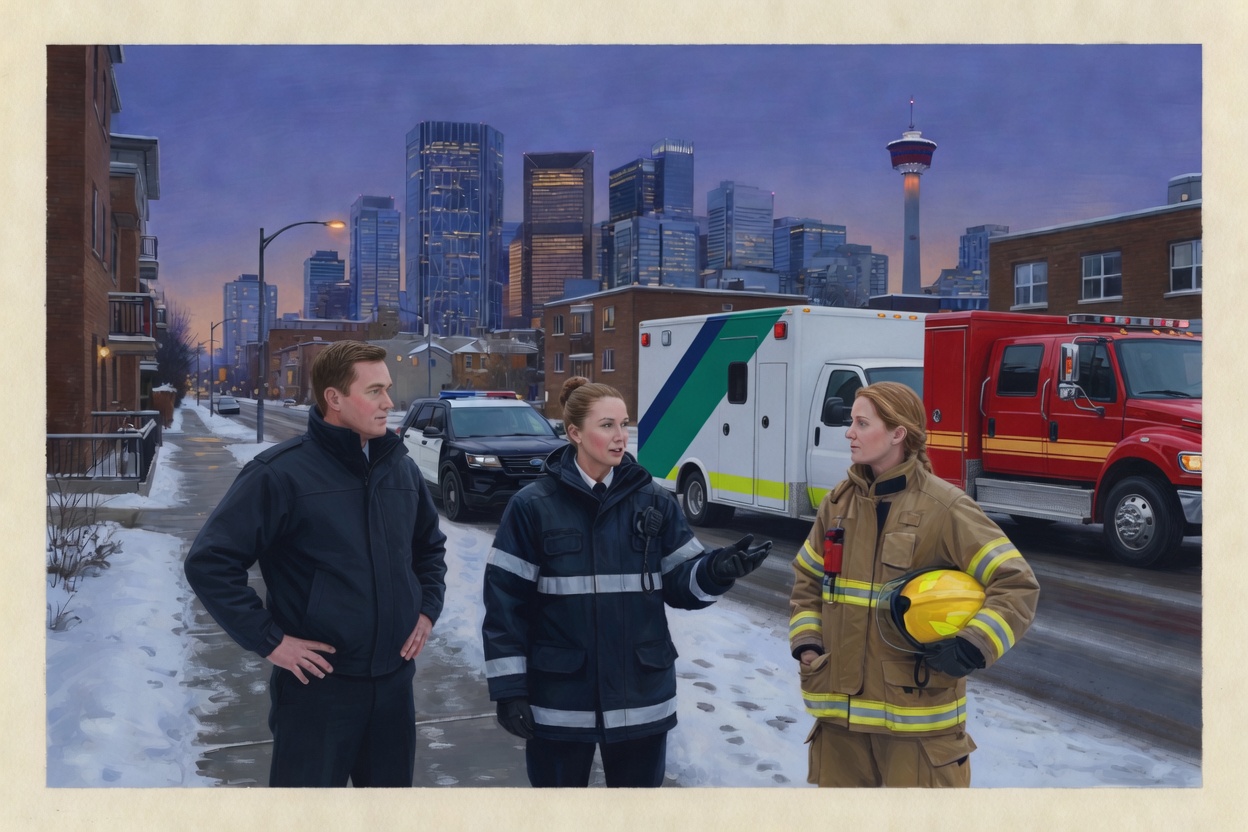
§ 01 — The people who run toward it. Calgary police, fire, and EMS answer the same call from three directions.
You signed up to run toward emergencies — fire, crash, crime, medical. On a typical tour after 2020 you still do that work, and you also face a large and growing share of human distress that has nowhere else to go. The radio still says “priority,” but the call is often not a classic emergency you can extinguish or extricate. That is the shift this guide trains for.
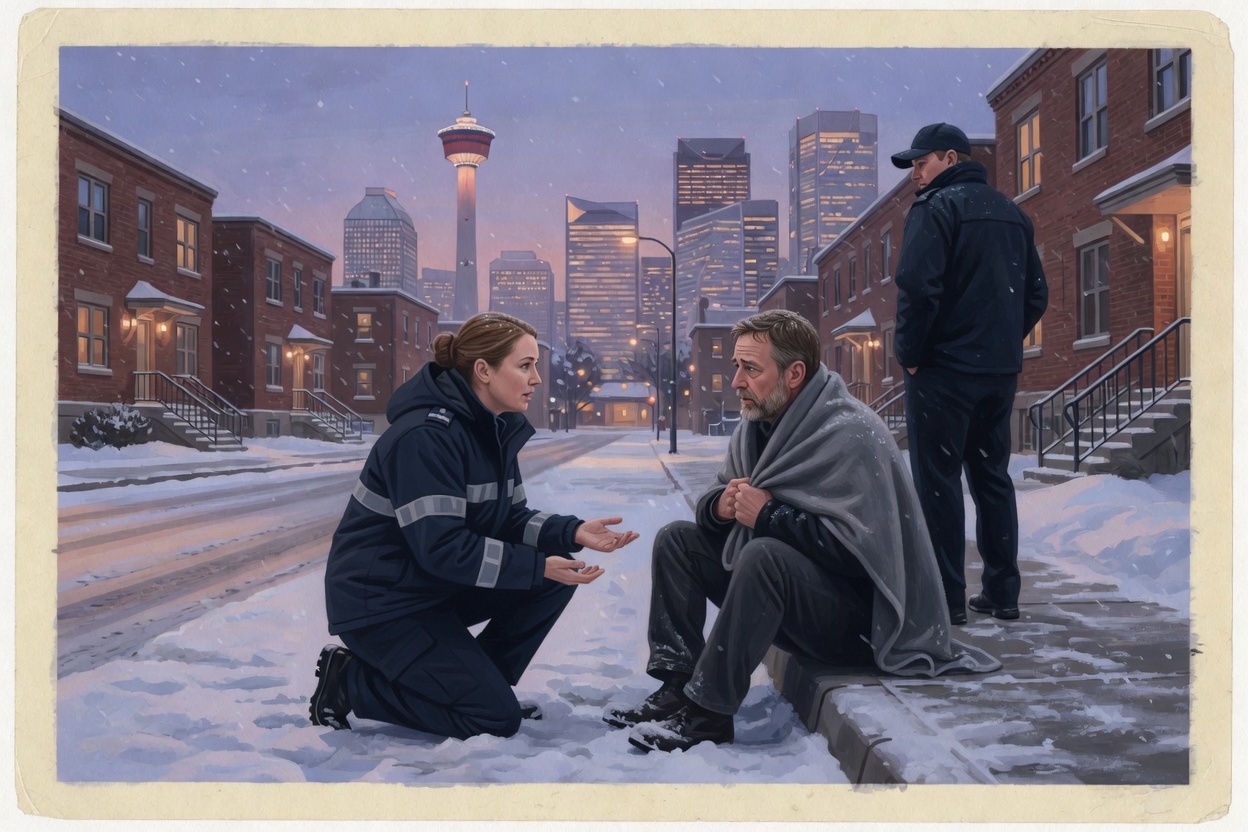
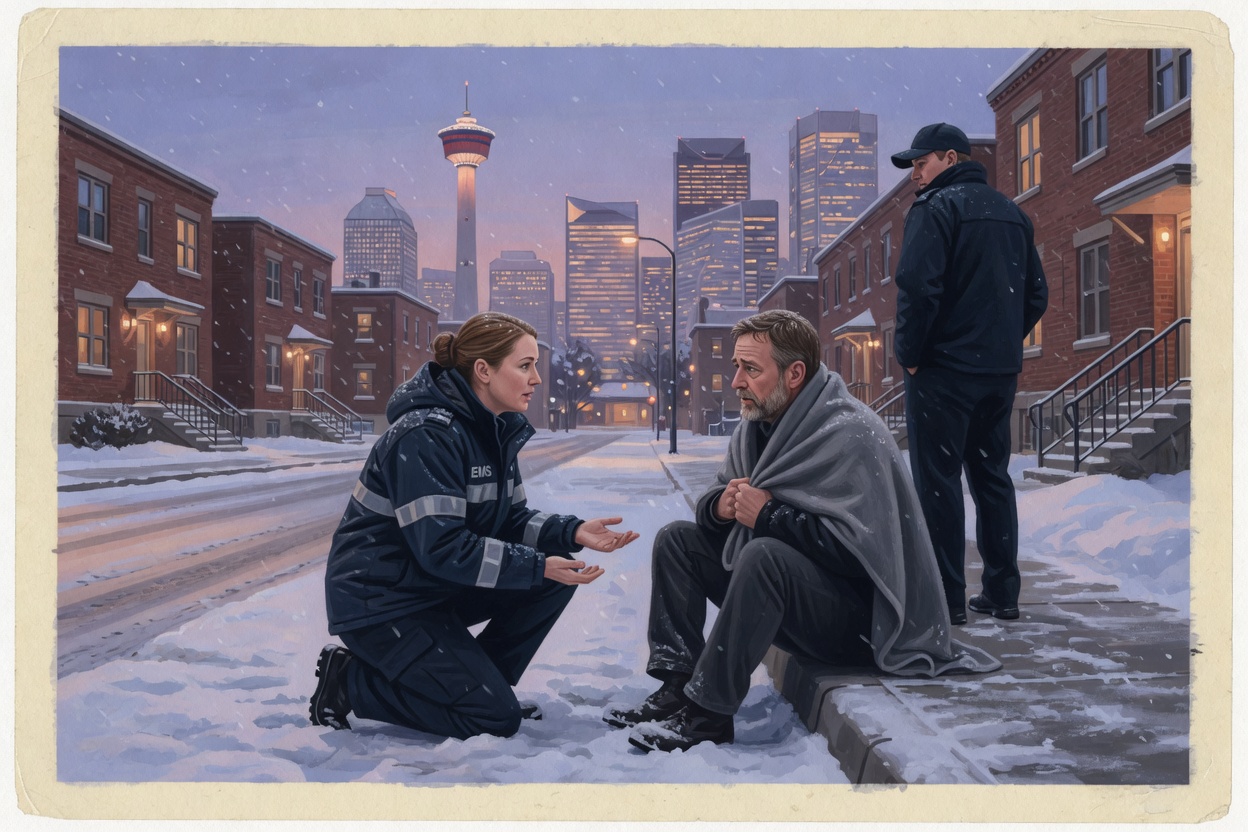
Figure 1. Treat the person, not the label. Eye-level, open hands, one voice. The second uniform stays back so the nervous system across from you is not surrounded.
This field guide is built on one idea WestNet carries into everything it does: treat the person, not the label, and fix problems at the source. A “frequent flyer” is a person whose underlying need keeps going unmet. An “EDP” or “10-96” is a human being in the worst moment of their week. And the responder who is short-tempered on the third overdose of a night shift is not a bad cop or a burnt-out medic — they are a nervous system that has been pushed past its limit and given no way to reset.
The WestNet Way — In One Breath
Make humans human again. The person in crisis is a human first and a call type second. You are a human first and a uniform second. Address the cause — the unmet need, the untreated injury, the exhausted body — rather than only silencing the symptom in front of you. Symptoms managed are symptoms that come back; causes addressed are calls that stop repeating.
Lens I
Treat the Person, Not the Label
“Drunk,” “junkie,” “psych,” “regular” — the moment a label lands, you stop seeing the person. The label becomes the call. Lead with the human in front of you and let the facts, not the shorthand, drive your response.
Lens II
Cause, Not Just Symptom
The overdose is a symptom. The shouting is a symptom. Ask what is underneath — pain, trauma, withdrawal, poverty, a missed dose of a real illness — and your decisions get safer and your repeat calls drop.
Lens III
Make Humans Human Again
Dignity is an operational tactic, not a luxury. People who feel seen fight you less, comply more, and remember you fairly. The same is true inside the hall and the station: crews treated as humans last longer and respond better.
Lens IV
Protect the Responder at the Source
You cannot pour from an empty canteen. Sleep, peer support, and processing what you see are not soft extras — they are the maintenance schedule that keeps you sharp, safe, and able to come home whole.
A Word on Tone
This guide is unreservedly pro-responder and pro-community. The critique is narrow and specific: when systems reach for a label or a pill instead of the cause, people — including responders — get worse, not better. The fix is more humanity and better root-cause thinking, applied with the right tool at the right time.
What Changed Since 2020
§ 02
§ 02 — The call mix changed. More mental-health and social-disorder calls, often after midnight.
Something shifted in the work after 2020, and most responders felt it before anyone named it. The pandemic did not create these forces, but it accelerated and compounded them — a deadlier illicit drug supply, an isolation-driven wave of mental-health distress, crews stretched thin by attrition and illness, and a public whose trust in institutions had been shaken and whose every interaction with you might be recorded.[1] The job did not get easier; it got more human, and more exposed.
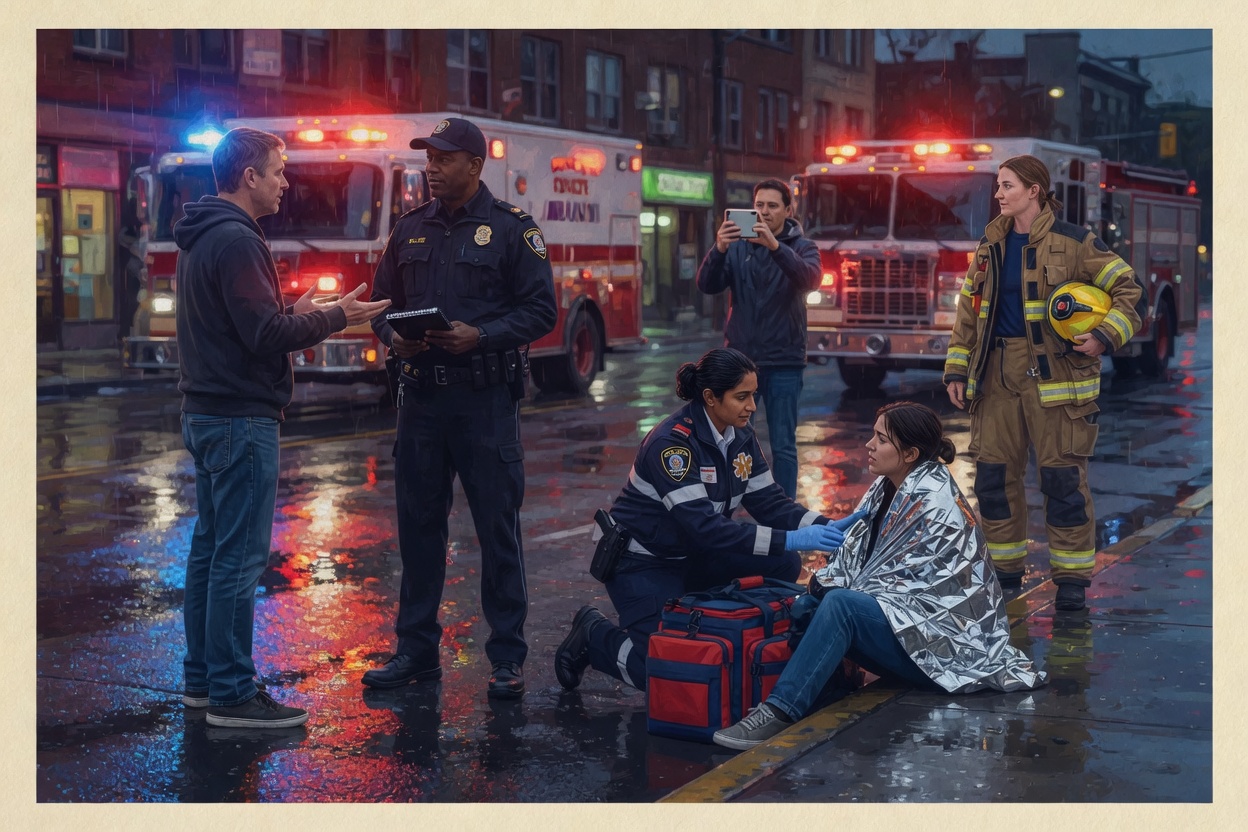
Figure 2. The post-2020 mix on one wet street: medical distress, a talking bystander, cameras running, three services sharing the same patch of pavement. Communication sits beside traditional skills; it does not replace them.
That does not mean the public is the enemy, or that force and speed no longer matter when lives are on the line. It means the mix of work changed. On many tours you still run classic trauma and fire — and on the same tour you also run distress, overdose, and social disorder. Communication, de-escalation, and self-regulation sit alongside traditional skills; they do not replace them when immediate life-safety is on the line.
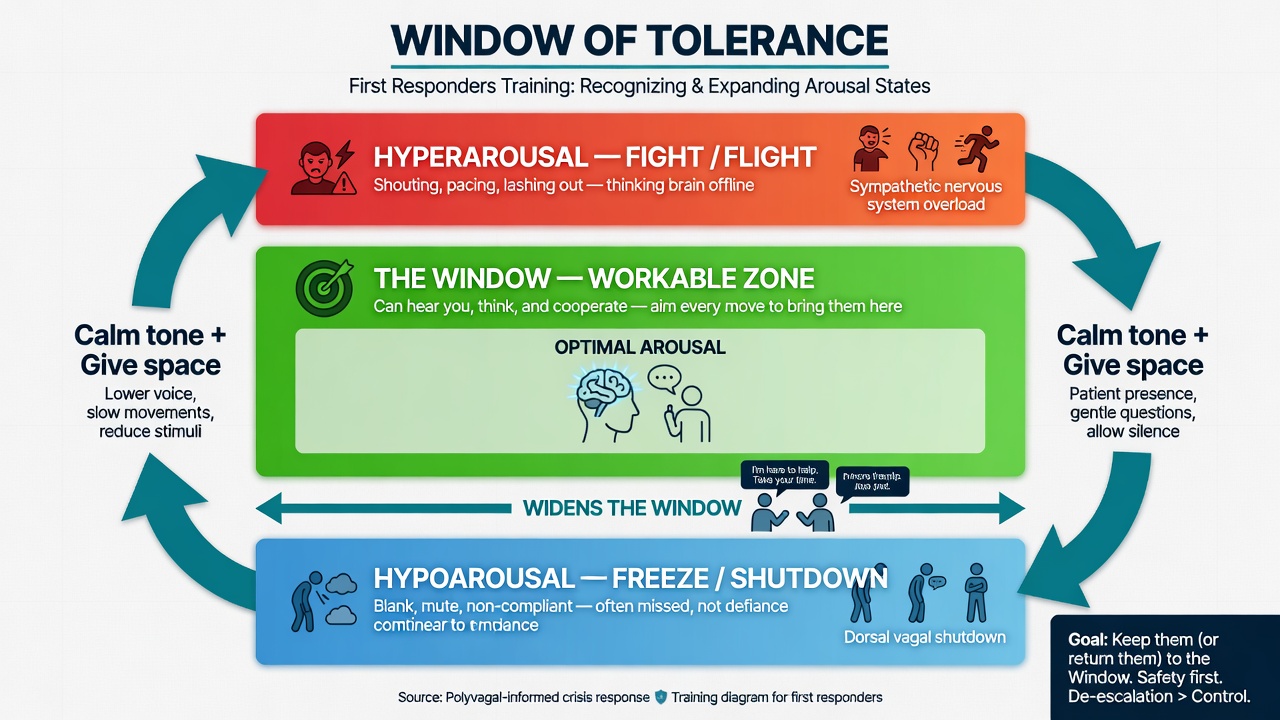
The window of tolerance is the zone where a person can still hear you and cooperate. Above it: fight/flight. Below it: freeze/shutdown. How to widen that window on a call is taught in §09 Trauma-Informed De-escalation — not here.
What This Section Is (and Is Not)
This section (§02) names the operating shift since 2020: more human distress on the radio, thinner crews, more cameras, less trust.
It is not the full de-escalation toolkit. Voice, space, time, validation, choice, and the interactive brancher live in §09 so you only learn them once, in the right place. Jump there when you are ready for the how-to.
Calgary / Alberta
Local programs, off-ramps, and street context are in §08 Alberta & Calgary. Scene-stacking and what the body carries after a bad night are in §05.
The New Call Mix — Mental Health & Social Disorder
§ 03
§ 03 — A person in crisis is not a threat to be managed, but a human to be reached.
Across North America, agencies report that a substantial and rising share of calls now centre on mental-health crises, substance use, homelessness, and social disorder rather than classic crime or trauma.[2] Major bodies — including police leadership associations and public-health agencies — have publicly described policing and EMS as the “default responders” to a mental-health system that cannot meet demand.[3] The exact proportion varies by city and by how calls are coded, so this guide deliberately avoids inventing a precise percentage; the documented direction is what matters operationally.
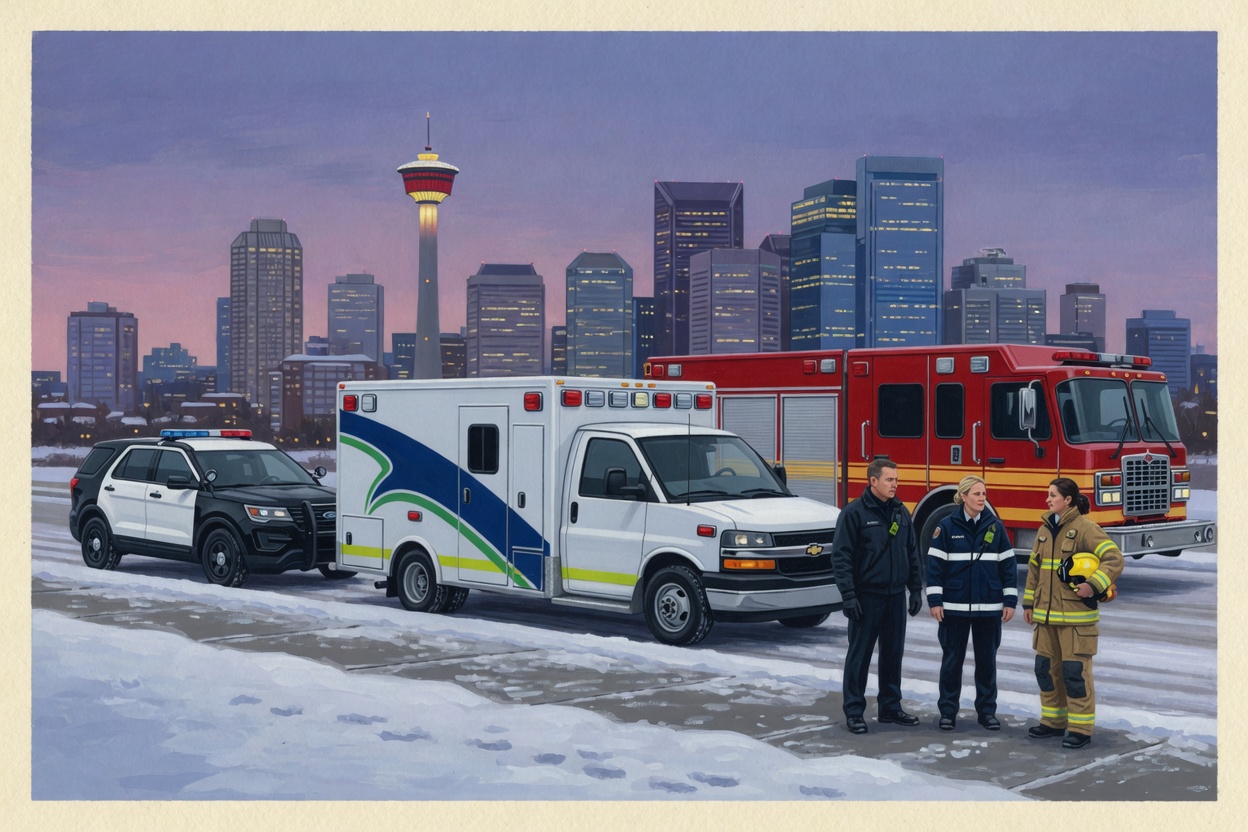
Figure 3. Police, EMS, and fire now share the same human-distress load. The toolkit in this guide is written for all three — the science of a flooded nervous system does not care which uniform you wear.
Why does this matter for how you work a call? Because a distress call is not solved the way a fire or a collision is. You cannot extinguish loneliness or extricate someone from psychosis. These calls are won with time, tone, and connection — the trauma-informed toolkit in §09 — and with knowing where the off-ramps are: crisis teams, co-response units, and community resources rather than a cell or an ER hallway.
Interactive Below — Reframe the Call
The tool below pairs common “labels” with the root-cause reframe and the responder move that fits. Tap each card to flip from the dispatch shorthand to what is usually underneath. The goal is not to diagnose — it is to keep you curious and humane when the radio hands you a label.
A Note on “Frequent Utilizers”
A small number of people generate a large number of calls — almost always because an underlying need (housing, addiction treatment, a real psychiatric or medical condition) is going unmet. Punishing the symptom guarantees the next call. Connecting the person to the right resource — the cause — is what actually lowers your volume. This is root-cause thinking applied to your own workload.
Staffing, Burnout & Public Trust
§ 04
Three pressures now sit on top of every call. Staffing shortages mean fewer units, longer waits, mandatory overtime, and crews held over past exhaustion. Burnout — the chronic depletion that follows — is widely documented across EMS, fire, and policing, and it erodes exactly the patience and judgment the new call mix demands.[4] And public-trust erosion means you may arrive to a scene already primed for conflict, with cameras running and a community that has reason to be wary.
These are not excuses; they are operating conditions. The responder who understands them can compensate for them. A tired brain narrows, rushes, and reaches for force — so the antidote is to deliberately slow down, communicate more, and lean on the crew. A wary public calms fastest when the first thing you offer is transparency and respect (see §09 and §10).
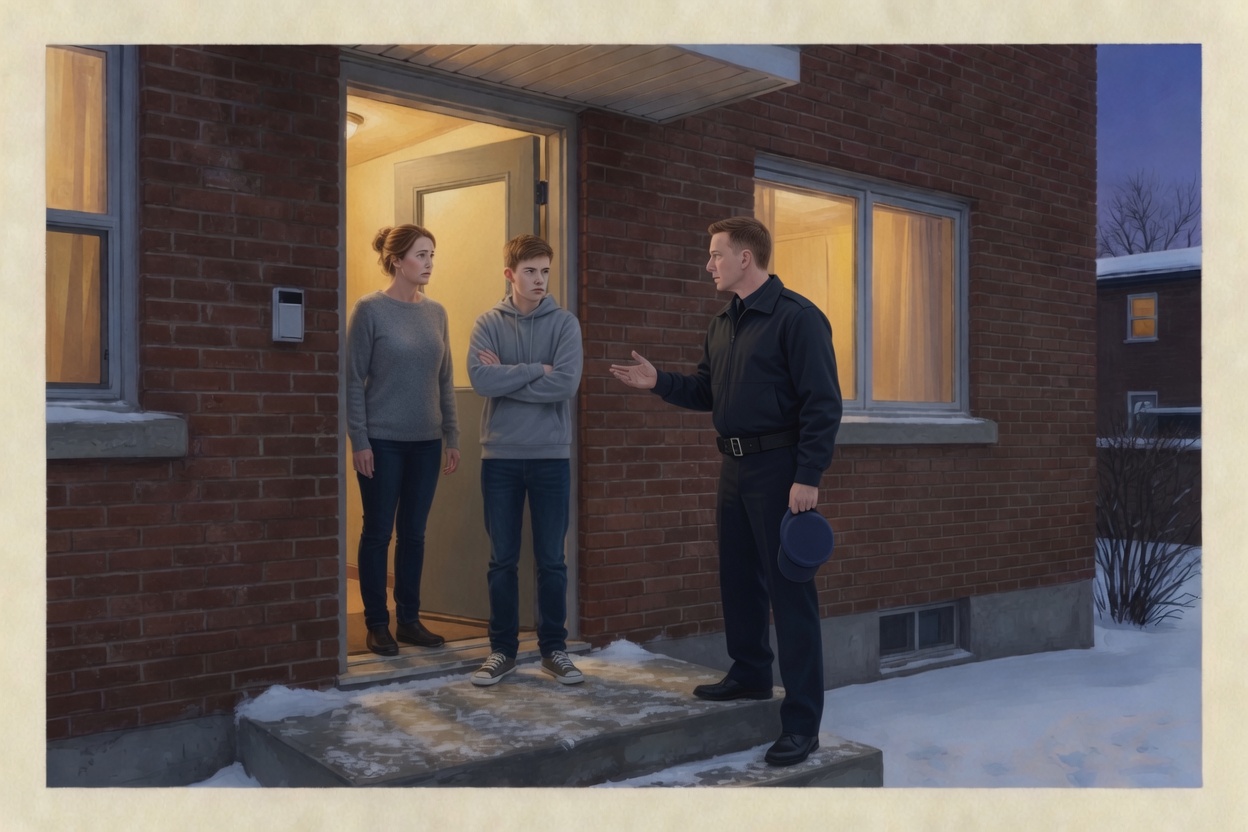
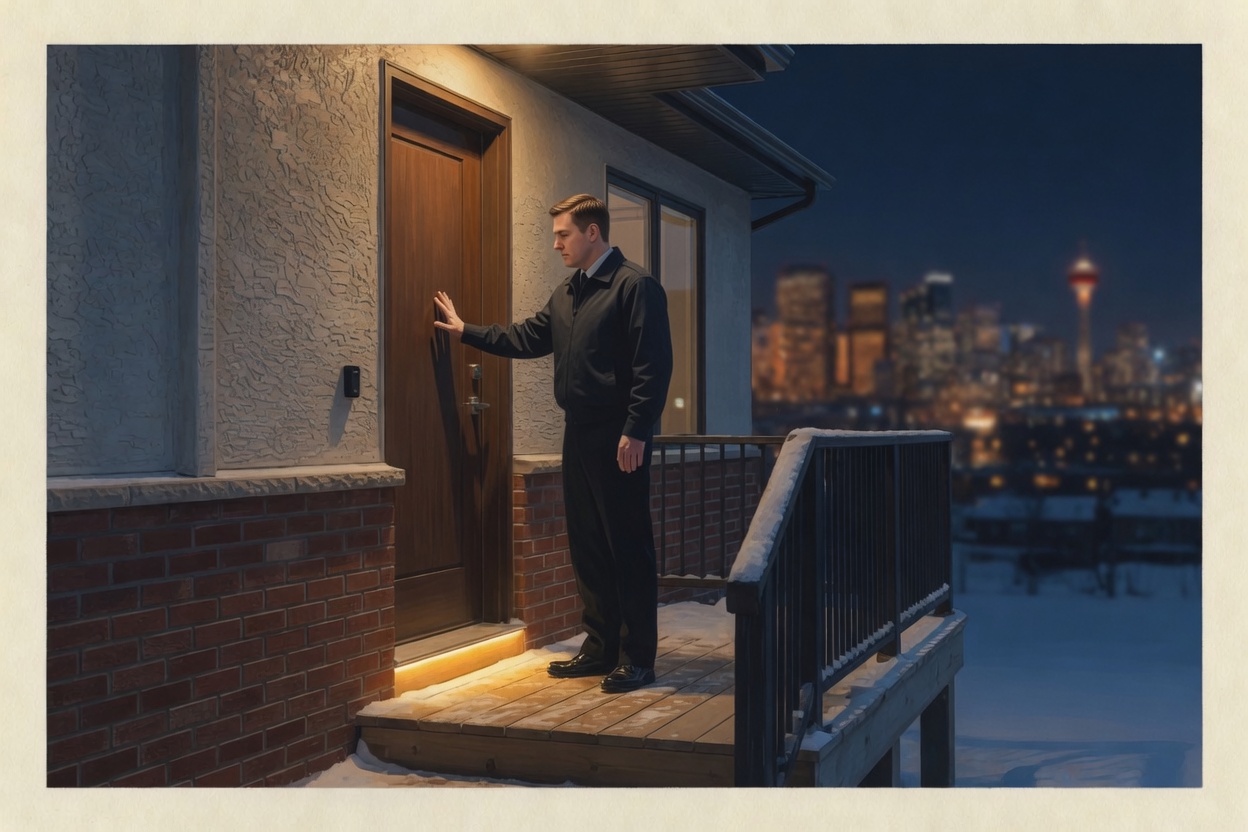
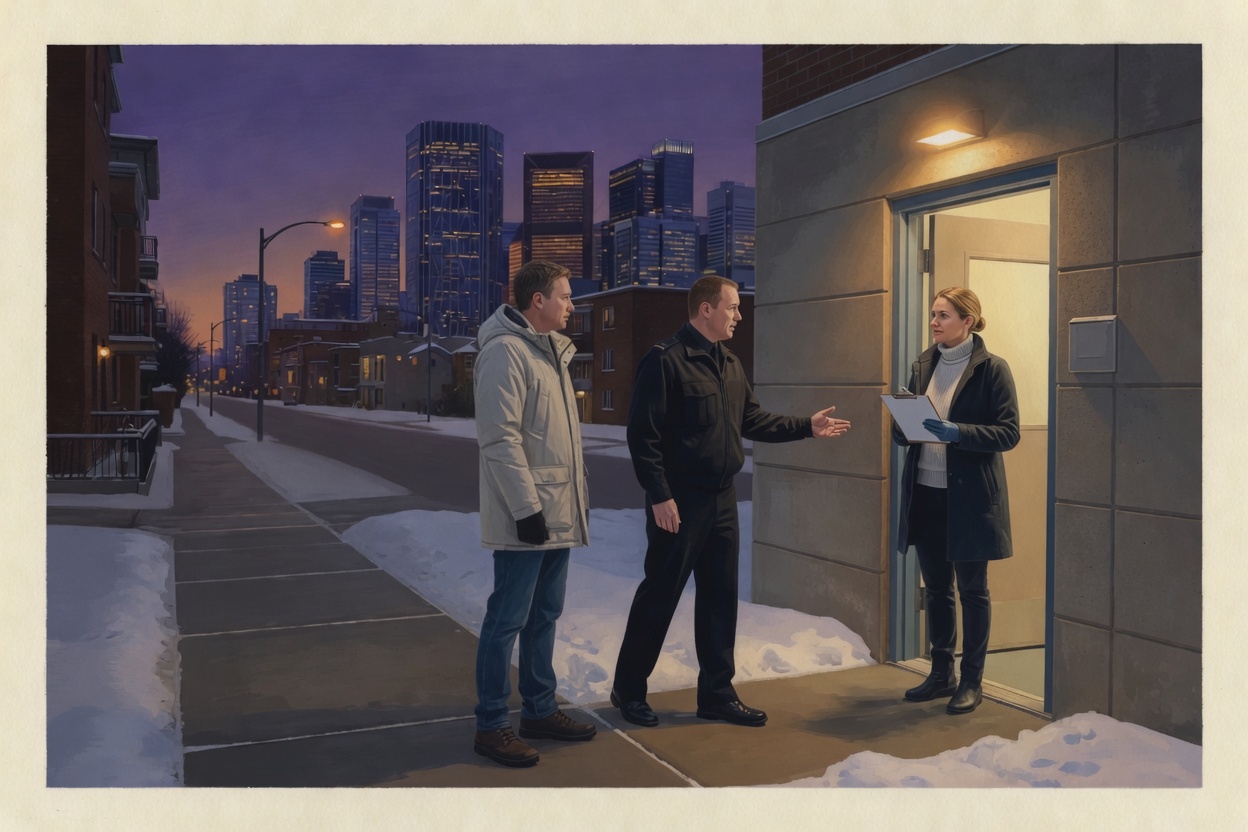
Figure 4. Name yourself and your purpose on arrival. Cap in the hand, palms visible, no crowding the threshold. Trust is built in the first thirty seconds, especially when cameras and history are already in the room.
Builds Trust & Buffers Burnout
Name yourself and your purpose on arrival, every time
Explain what you are doing and why, out loud
Treat the camera as a witness to your professionalism, not a threat
Share the load — tap out, debrief, ask for relief when fried
Slow the tempo when nothing is immediately life-threatening
Corrodes Trust & Deepens Burnout
Barking commands with no explanation
Treating every bystander or recording as hostile
Powering through exhaustion as a point of pride
Letting cynicism (“they’re all the same”) drive the call
Rushing a distress call as if speed were the goal
The Trust–Wellness Loop
Public trust and responder wellness are the same loop seen from two sides. A regulated, rested responder communicates better, escalates less, and earns trust — which makes the next call calmer, which protects the responder. A depleted one does the reverse. Fixing wellness at the source (§05, §12, §15) is therefore not just self-care; it is community safety.
The Responder’s Own Mental Health
§ 05
§ 05 — The toll is cumulative. What you carry home is part of the job no one dispatches.
First responders carry an occupational exposure to trauma that very few jobs match: sudden death, violence, dying children, the worst day of stranger after stranger — sometimes several times in one shift. The result, when it accumulates, has a name. Occupational stress injury (OSI) — including post-traumatic stress, depression, anxiety, and moral injury — is recognized across the profession as an injury, not a weakness or a character flaw.[5] Canadian research and the Tema Conter / public-safety literature have documented elevated rates of post-traumatic stress and psychological distress among public-safety personnel relative to the general population.[6]
Scene Hopping — What the Body Remembers
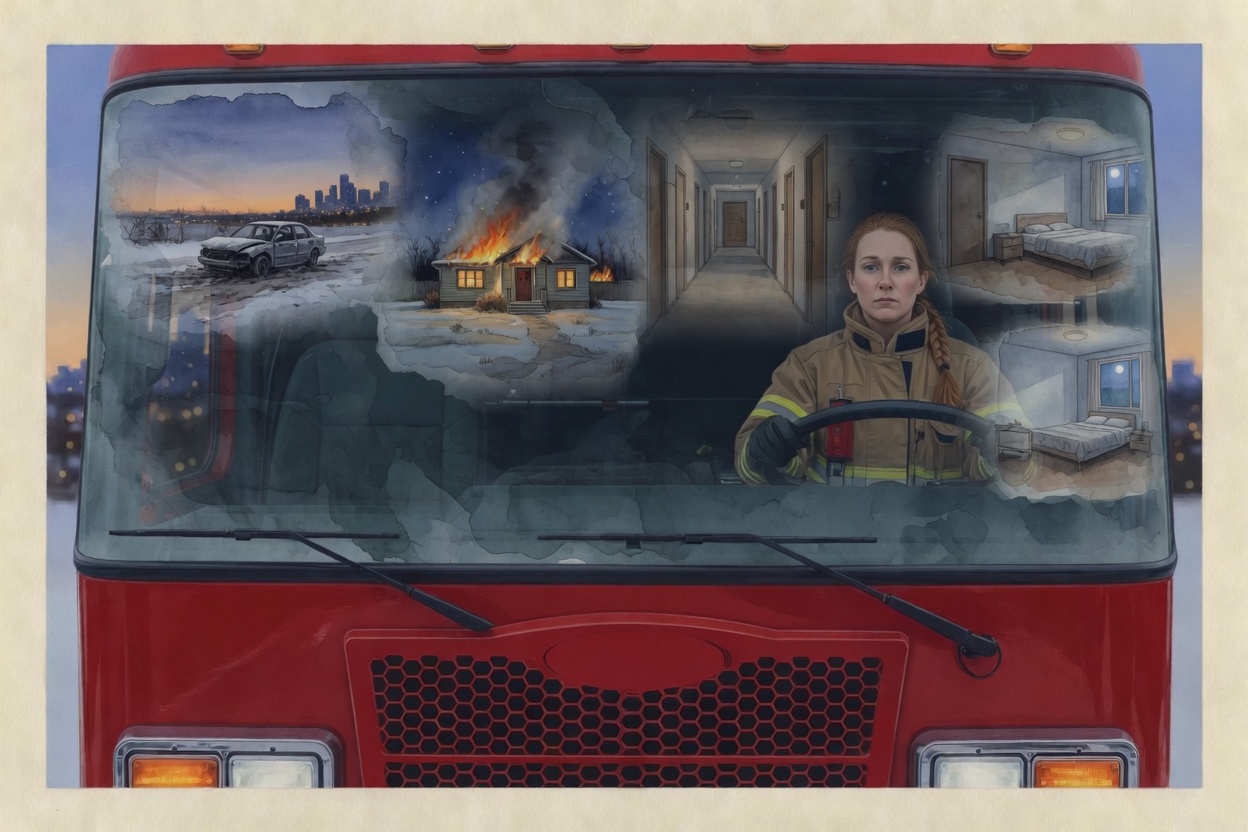
Calgary crews know the pattern: one call is a car wreck on Deerfoot; twenty minutes later a child not breathing in the deep SE; then a house fire on the north hill; then a fentanyl OD in a Beltline suite with the TV still on. You do not get a clean ending between them. Your nervous system does not file each scene in a neat folder. It stacks them — smell, sound, the look on a partner’s face, the one detail you cannot un-see.
Scene hopping is not just busy. It is repeated full-body threat activation without enough recovery time. The same biology that keeps you sharp on the call becomes the thing that will not stand down at 03:00 when you are staring at the ceiling. That is not a character flaw. It is cumulative trauma load — the occupational version of stacking weights on a bar without ever racking it.
Figure 5. What the body remembers. Scene-hopping does not file each call in a neat folder. The wreck, the fire, the hallway, and the quiet bedroom stack behind the glass. Reset between them (§12–§13) is how you rack the bar.
Messed-Up Things You Carry Home
First responders routinely see what most civilians never will: violent death, child injury, suicide, bodies in decay, family members screaming in a doorway, the quiet after someone does not come back. The professional mask is useful on scene. It is poison if it is the only face you wear for twenty years.
What helps: name what you saw (to a peer, a chaplain, a clinician — not only to the void); reset between calls even for sixty seconds (feet on floor, water, one honest sentence with your partner); decompression before the front door so home is not the first place the horror lands. Calgary and Alberta peer-support and OSI pathways exist for a reason — use them before the stack collapses.
The WestNet position is the same here as everywhere: fix it at the source. Sleep, decompression, processing calls, peer support, and treating moral injury as the wound it is — these address the cause. Reaching reflexively for a sedative or a sleeping pill, with nothing else changed, only mutes the alarm while the fire keeps burning (the over-medicalization trap, §06). Medication, prescribed appropriately by your own clinician, is a legitimate tool — but it works best alongside root-cause work, never instead of it.
Injury, Not Weakness
A torn shoulder from a lift is an injury you would never hide. An OSI is the same: a normal response of a normal nervous system to abnormal, repeated exposure. The strong move — the one that keeps you on the job longer — is to treat it early, not to outlast it in silence. Destigmatizing this in the hall and the station saves careers and lives.
Interactive Self-Check
Occupational Stress Load — Self-Calibrator
Slide to reflect how heavy the cumulative load feels right now — sleep debt, calls replaying in your head, numbness, irritability, dread before shift. This is a private reflection aid, not a diagnosis and not a screening test. If anything here resonates, the next move is a conversation — with peer support, your family doctor, or the crisis lines in §16.
5/10
Carrying a real load
0 · Steady5 · Loaded10 · Overloaded
Root-Cause Moves
A real but manageable load. Tend to it now, before it compounds.
Higher load → the more it needs addressing at the source: rest, connection, processing, and professional support — not just powering through. None of this ends a career; ignoring it can.
Moral Injury — The Quiet One
Not every wound is fear-based. Moral injury is the damage done when you witness, or feel forced into, something that violates your own moral code — the call you could not save, the order you doubted, the person the system failed in front of you. It shows up as guilt, shame, and loss of meaning rather than panic, and it responds to meaning-based repair: talking it through, restoring purpose, and being reminded that you are a good person who was put in an impossible place.
The Over-Medicalization Trap
§ 06
Here is a hard, diplomatic truth: more pills is not more care. First responders, like the patients they transport, can be funnelled into a default where every problem meets a prescription — something to sleep, something for pain, something for the nerves, something to counter the side effects of the last thing. Each may be reasonable alone. Stacked, with no one minding the whole picture and the cause left untouched, they become their own problem.
This is not an anti-medicine message. Medications save lives, and a responder who needs treatment should get it without shame. The critique is narrow and evidence-based: polypharmacy — multiple drugs whose interactions and cumulative burden outweigh their benefit — is a well-documented harm, and the reflex to treat every symptom with another agent often skips the cheaper, durable fixes: sleep, movement, peer support, processing trauma, and addressing the metabolic and lifestyle roots of how a body feels.[7]
Right Tool, Root Cause First
WestNet’s rule is not “no medication.” It is right tool, root cause first. Before another agent is added — for you or for a patient — ask what is actually driving the symptom and whether a non-drug fix addresses it more durably. Then use medication deliberately, with one clinician watching the whole list, rather than reflexively.
Root-Cause First
Fix sleep with schedule, light, and decompression before reaching for a hypnotic
Treat pain’s source; pair any analgesic with movement and rehab
Process trauma with peer support and therapy, not sedation alone
Keep one clinician reviewing the entire medication list
Address metabolic & lifestyle drivers of mood and energy
The Trap
A new pill for every new symptom
Stacking sedatives, stimulants, and painkillers with no oversight
Treating side effects with yet another drug (the prescribing cascade)
Mistaking a quiet, medicated responder for a recovered one
Leaving the cause — sleep debt, trauma, injury — untouched
Figure 6. Right tool, root cause first. The bottles are not the enemy — stacked, unreviewed pills with the cause left untouched are. Sleep, movement, and a real conversation with a peer are the cheaper, more durable start.
Cross-Reference — WestNet Medical Modules
This theme runs through the WestNet Medical CE series. For the clinical depth, see
Module 06 — Polypharmacy & Iatrogenic Harm (how stacked medications and prescribing cascades cause harm) and
Module 10 — Root-Cause & Metabolic Approaches (addressing the upstream drivers rather than the downstream symptom). The principle is identical for responders and patients alike: treat the person, not the label; the cause, not just the symptom.
Said Plainly, Said Kindly
If you are a responder being handed a third or fourth prescription and no one has asked about your sleep, your calls, or your home life — that is a signal to seek a clinician who will look at the whole picture. You deserve root-cause care, not just symptom management. Bring this page if it helps start the conversation.
The North American Opioid Crisis
§ 07
§ 07 — The naloxone era. Every door can open onto an overdose; response is core skill now.
The illicit drug supply across the United States and Canada is now dominated by fentanyl and its analogues — synthetic opioids so potent that a dose invisible to the eye can be fatal, and so unpredictably mixed that the person who used it rarely knows what they took.[8] Carfentanil and other ultra-potent analogues appear in the supply, and increasingly opioids are mixed with stimulants, benzodiazepines, or veterinary sedatives such as xylazine, which complicate the overdose picture because they do not respond to naloxone.[9] Public-health surveillance in both countries documents this as a sustained, worsening trend — the specific numbers move and differ by jurisdiction, so this guide points to the official trackers rather than quoting a figure that would be out of date by the time you read it.
For responders, the operational reality is: more overdoses, more poly-substance presentations, and real but manageable scene-safety considerations. The dignity lens matters here as much as anywhere — the person on the floor is somebody’s child, and the way you treat them when they wake is something they will remember.
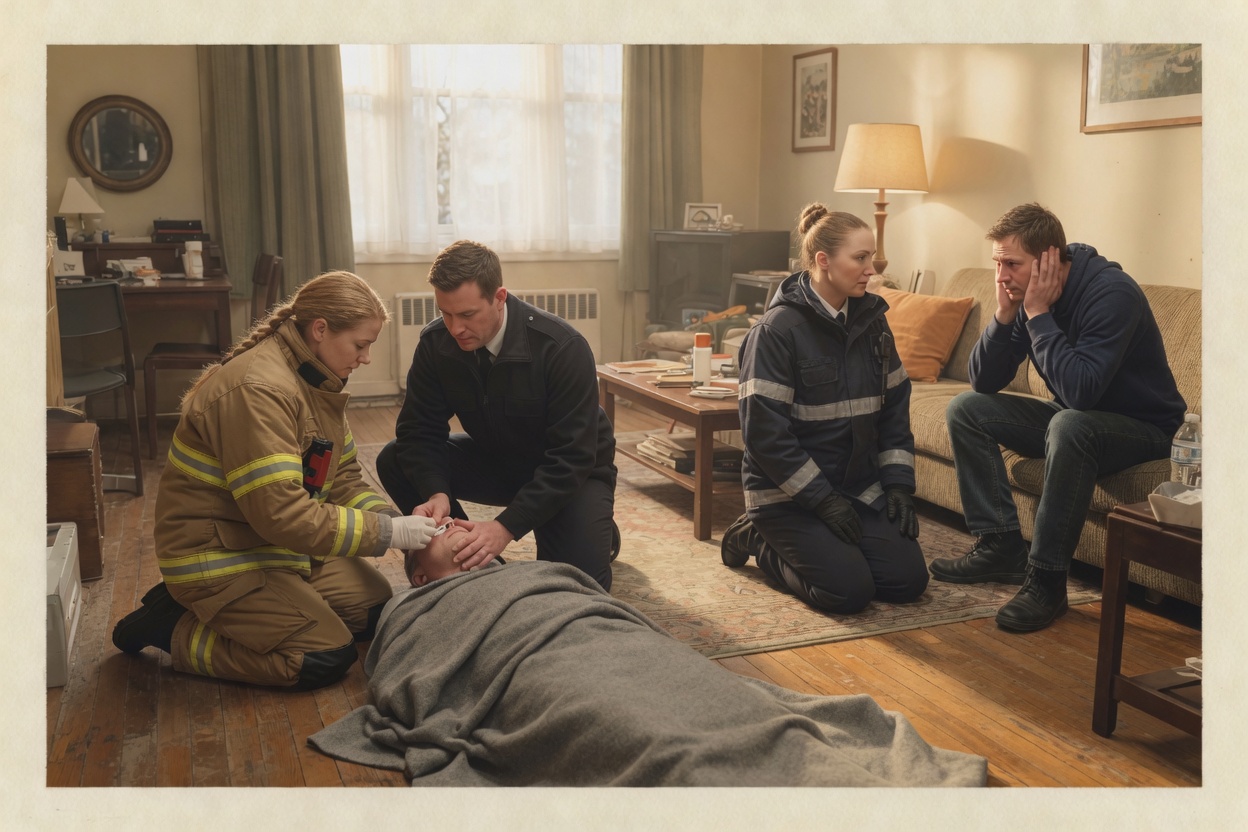
Figure 7. Proportionate, not panicked. Airway, naloxone, dignity. The roommate in the doorway is part of the call — they will remember how you treated the person on the floor. Follow your agency protocol and medical direction.
Scene Safety — Proportionate, Not Panicked
Health agencies are clear that incidental skin contact with fentanyl does not cause overdose, and that the dramatic “collapse from touching powder” stories are not supported by the toxicology.[10] Use routine precautions — gloves, avoid aerosolizing powders, do not eat or touch your face, ventilate enclosed spaces — but do not let unfounded fear delay care or dehumanize the patient. Always follow your agency’s current exposure protocol and medical direction.
The load this places on crews is real, and in Calgary it has grown heavy enough to strain the service itself. The Calgary Fire Department and its engine crews — not only EMS — are now frequently first on scene at overdoses and poisonings, and they are running them at a volume that increasingly overwhelms a fire service never staffed to be a primary overdose-response system.[11] This guide puts no invented number to that — the counts move and belong to the official surveillance dashboards in §08 and §22 — but the documented direction is plain: the calls are arriving faster than the relief. That lands squarely on the same scene-safety and root-cause threads above. More frequent exposure is precisely why routine precautions stay routine; and the rising volume is itself a symptom of upstream causes — an unpredictable drug supply, untreated pain and trauma, thin treatment access — that no single crew, however overwhelmed, can be expected to fix alone.
Why Fire Crews Are on These Calls
As the nearest available unit, engine companies often arrive before a transport unit — so firefighters carry naloxone and run overdose calls as a core part of the modern job, not an exception. Increasingly they run a great many of them: the frequency, documented through provincial substance-use surveillance and local services (§08), has climbed to where it weighs on crews as a genuine workload and wellness pressure, not a clinical one alone (see §04). Read it live rather than memorizing a figure. The operational takeaways do not change with the count: proportionate scene safety, competent airway and naloxone care per protocol, dignity on revival, and a warm hand-off toward treatment that addresses the cause — and, for the service, honest attention to the toll that this volume takes on the people running it. Verify against your agency’s current protocol and medical direction.
A three-step decision aid for a suspected opioid overdose, built on the standard recognize–respond sequence. It is a teaching refresher only. Your training, your protocol, and your medical direction always govern the real call.
Overdose Response · Step 1 of 3
Harm Reduction AND Root Cause
Naloxone, take-home kits, and non-judgmental care keep people alive — and a person has to be alive to recover. That is harm reduction, and it is not in tension with root-cause thinking; it is the first step of it. The deeper causes — untreated pain, trauma, poverty, lack of treatment access — are what drive the demand. Reviving someone with dignity and connecting them to treatment and social supports addresses the symptom and opens the door to the cause. Both, not either.
Alberta & Calgary Context
§ 08
§ 08 — Alberta winters, Calgary streets. Local context shapes every call.
This is the Calgary Edition, so the guide grounds the national picture in Alberta’s real, public response. Alberta operates a substance-use surveillance system and publishes ongoing data on opioid-related harms through the provincial government; Alberta Health Services (AHS) delivers EMS and health services province-wide; and the Calgary Police Service (CPS) has publicly invested in officer wellness and in co-response models that pair officers with mental-health professionals.[11] These are documented, citable programs — this guide references their existence and direction without inventing specific figures, which change continually and should be read from the official dashboards.
Calgary On the Ground
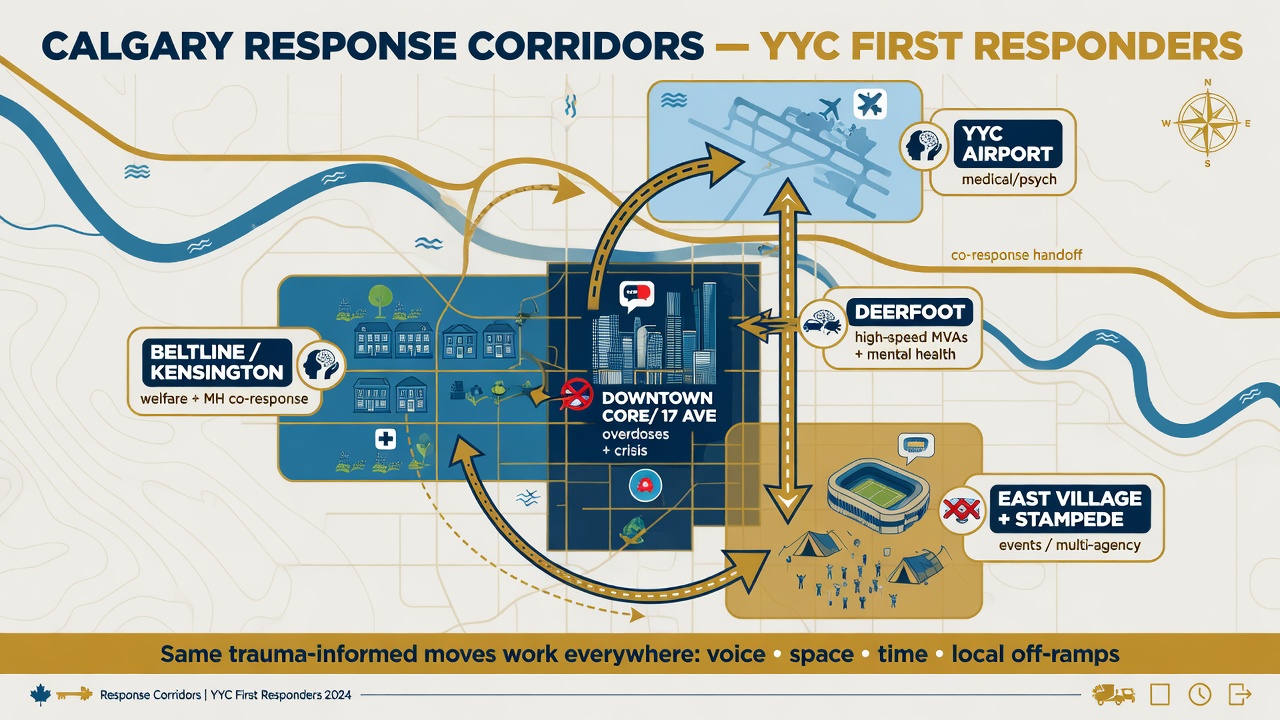
This edition is grounded in corridors and services Calgary responders actually work: the Beltline and East Village densification and street disorder; the SE industrial / residential mix with long response runs; Deerfoot, Crowchild, and Stoney high-speed trauma; river pathways and parks after dark; and the reality that CFD engines and AHS EMS often share the same first-on-scene load while CPS runs co-response and wellness programs that still leave individual members carrying the night home.
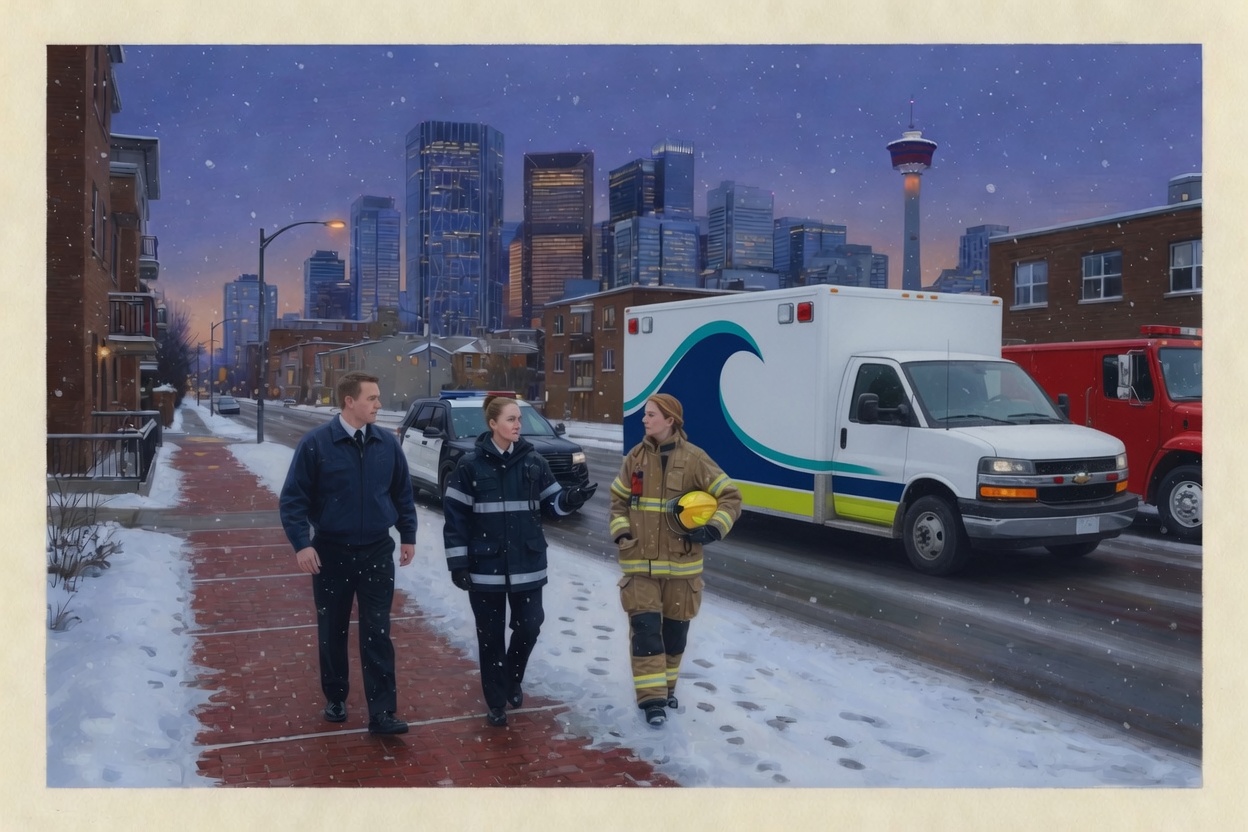
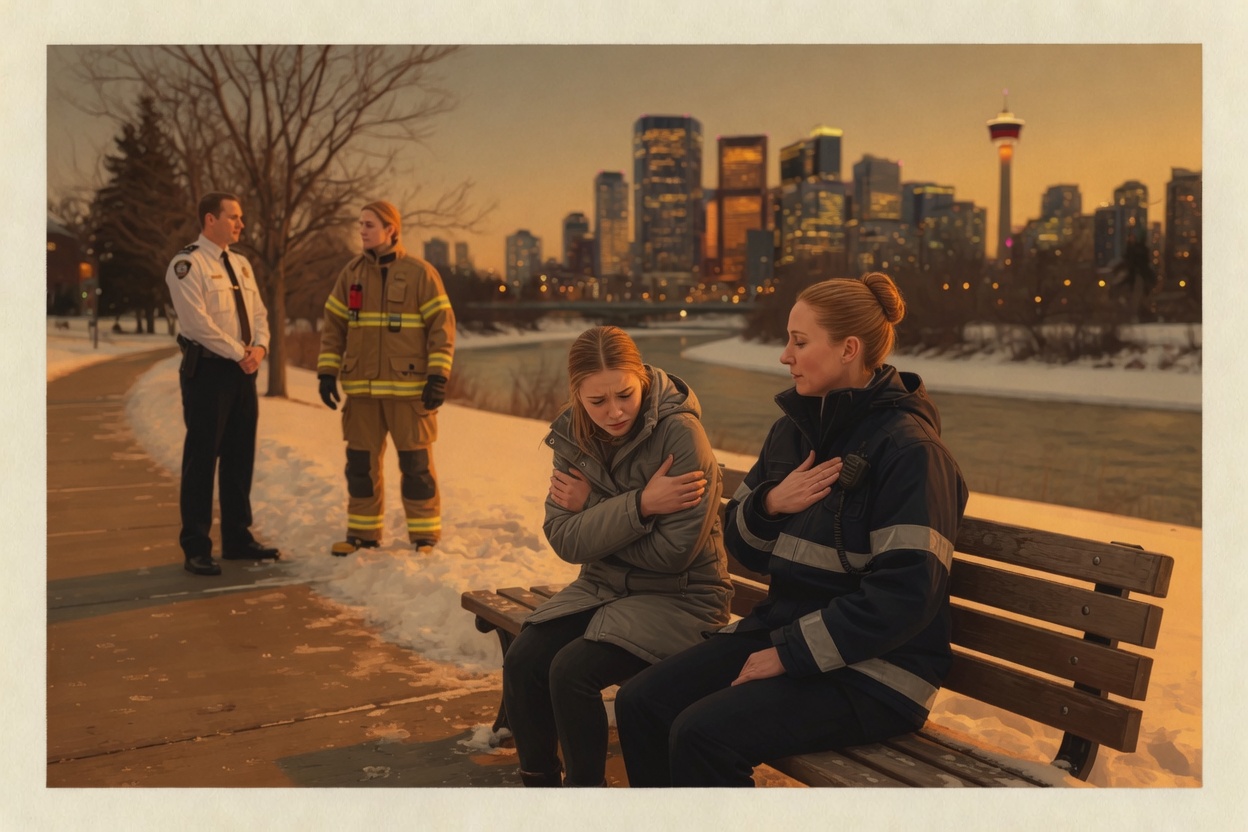
Weather is not a footnote here. Chinooks, −30 snaps, black ice, and summer hail storms change scene time, patient presentation, and crew fatigue in the same shift. Build your personal reset around this city’s tempo — not a generic textbook shift.
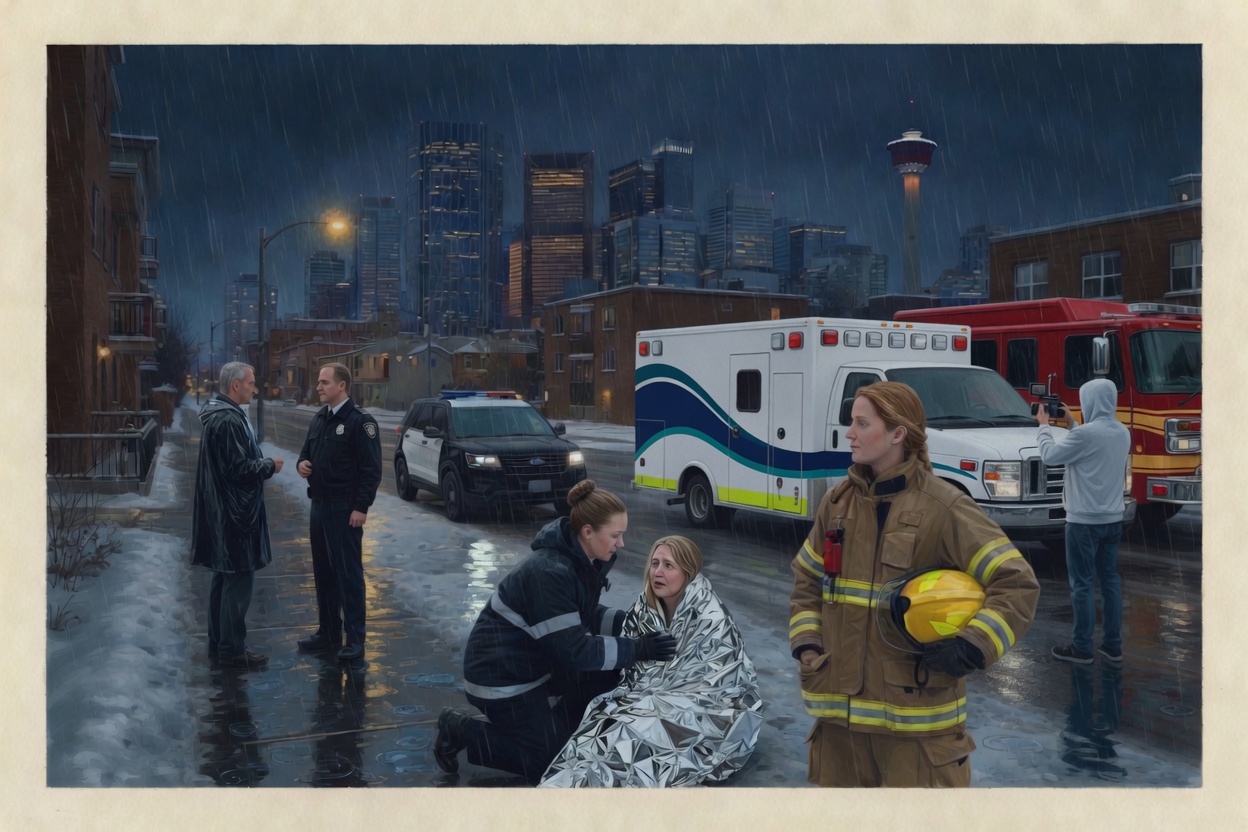
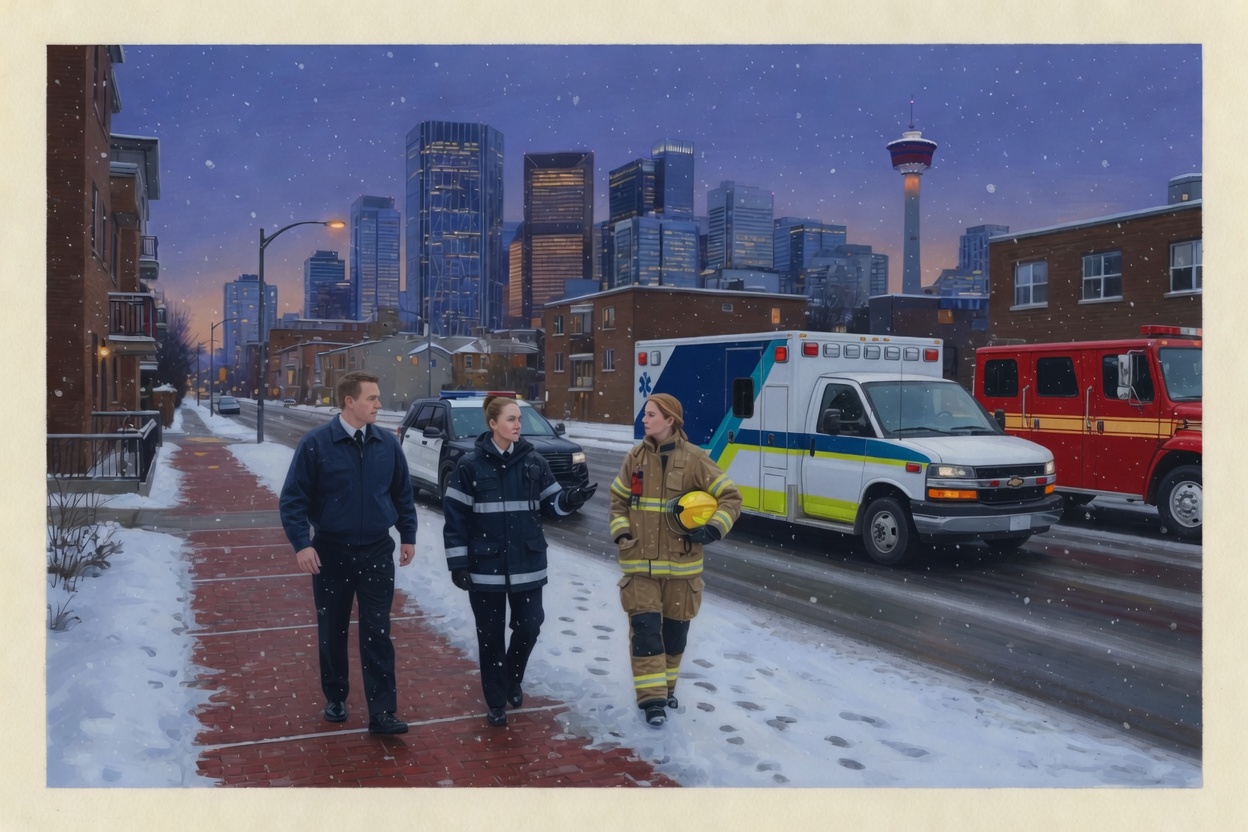
Figure 8. Calgary, winter, Beltline. Brick walk-ups, downtown towers, snow, and three services on the same sidewalk. The city’s weather and corridors are operating conditions, not scenery.Figure 9. Calgary response corridors. Same trauma-informed moves work everywhere: voice, space, time, and the local off-ramps named in this section. Read live dashboards rather than memorizing a count.
When the Mess Sticks
If a particular Calgary call will not leave — the address you still drive past, the child’s room, the overdose who looked like someone you know — that is a signal, not a failure. Peer support, EAP, and clinical help are part of the kit, same as gloves. The strong crew culture is the one that normalizes getting help before the next scene stack.
Why localize? Because the off-ramps in §03 are real places with real names in your jurisdiction, and knowing them turns a circular call into a resolved one. In the Calgary and Alberta context that includes provincial naloxone distribution, the Alberta-wide health line (811), supervised and community treatment pathways, and police mental-health co-response and PACT-style teams. Your agency’s current resource list is the authority — verify the details locally.
Alberta
Substance-Use Surveillance
The Government of Alberta publishes ongoing opioid and substance-use harm data. Read the dashboard for current trends rather than memorizing a number — the picture updates regularly.
AHS
Health & EMS Delivery
Alberta Health Services runs provincial EMS and health programs, including naloxone access and addiction & mental-health services that responders can connect people to.
CPS
Wellness & Co-Response
The Calgary Police Service has publicly profiled officer-wellness initiatives and mental-health co-response partnerships — responders supported, and crises met with the right discipline.
Local
Know Your Off-Ramps
Crisis teams, shelters, withdrawal-management, and community paramedicine differ by area. Carry your agency’s current list; it is what converts a repeat call into a real referral.
Responsible Localization
Everything in this section is real and public. What this guide will not do is fabricate Calgary-specific statistics — overdose counts, officer-involved-incident figures, or domestic-violence rates. Those belong to official sources, cited in §22, and should be read live. Grounding your practice in your own jurisdiction’s real programs is the point; inventing precision is the opposite of it.
Trauma-Informed De-escalation
§ 09
§ 09 — De-escalation begins the moment you slow down and lower your voice.
De-escalation is now the single most valuable skill on most calls, and the science behind it is the same whether you wear blue, red, or white. WestNet Medical’s
Module 07 — De-escalating Aggression develops this in clinical depth; this section ports its core to the street, the rig, and the doorway. The central insight: most aggression is a survival response, not defiance. A flooded nervous system is not choosing to fight you — it is reacting to a threat it perceives, real or not.[12]
Three concepts do the heavy lifting. The window of tolerance is the zone where a person can think and cooperate; pushed above it (fight/flight) or below it (freeze/shutdown), the thinking brain goes offline and reason cannot reach them. Neuroception is the nervous system’s constant, below-conscious scan for danger — your stance, your tone, the crowd of uniforms all register before a word is heard. And co-regulation is the tool: a calm, regulated responder can literally settle a dysregulated person through tone, pace, and presence. Your calm is contagious — if it is genuine.
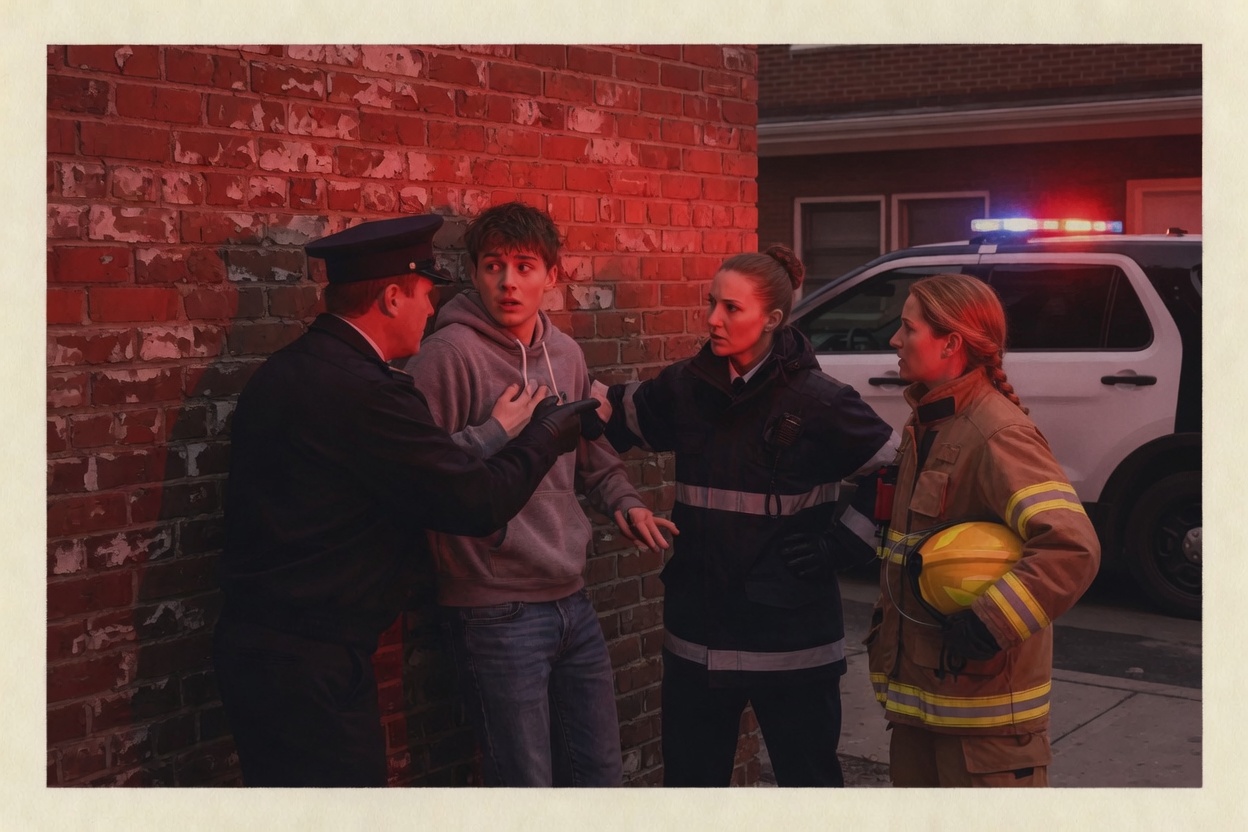
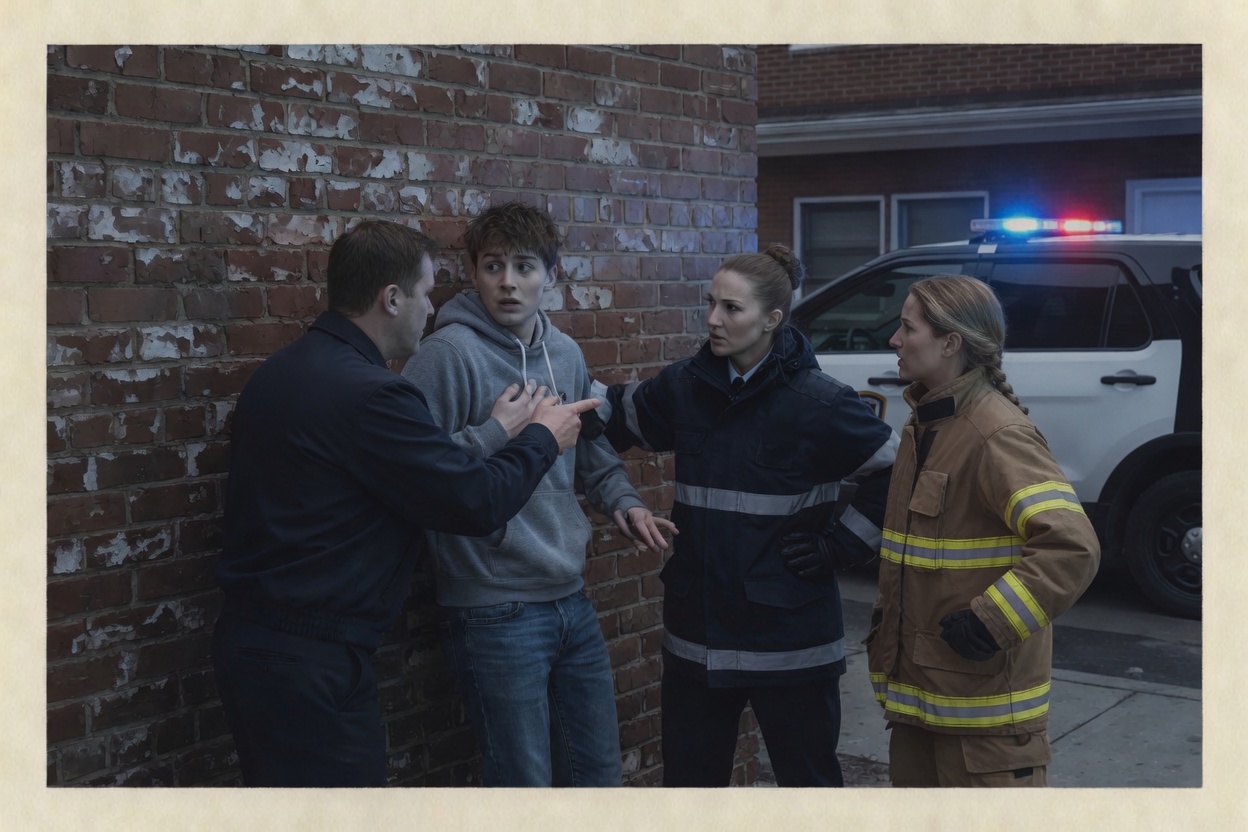
Crowding shrinks the windowFigure 10a. Looming, pointing, blocking the only way out. Neuroception reads this as danger before a word is heard.Space widens the windowFigure 10b. One voice, open hands, an obvious exit. The second responder stays quiet and back.
Voice
One Voice, Lower Tone
Designate one responder to talk; everyone else steps back and stays quiet. Drop your volume and slow your pace — the body co-regulates to the calmest nervous system present.
Try: “I’m here with you. Talk to me — just me.”
Space
Give Space & an Exit
Keep distance, keep your hands visible and open, and never corner a person or block their only way out. Crowding and looming read as threat to neuroception and guarantee escalation.
Time
Let Time Work
Slow is safe when nothing is immediately life-threatening. Silence is not failure — after you speak, wait. A nervous system needs seconds to climb back into the window.
Validate
Name the Feeling
Putting the emotion into words (“affect labeling”) measurably lowers the threat response. You are not conceding the facts — you are showing you see the person.
Try: “It looks like something here scared you. Did I get that right?”
Choice
Offer Real Choices
Trauma is powerlessness; choice is the antidote. Give two acceptable options so the person regains a sense of control, and pair any limit with a path forward, never a dead end.
Self
Regulate Yourself First
You cannot co-regulate from a dysregulated state. Slow your own breathing, unclench your jaw, drop your shoulders — then bring the other person down with you.
Figure 11. Co-regulation is contagious calm. Sit slightly aside, match a slower breath, one quiet presence. The rest of the crew stays back so the thinking brain can come online.
Interactive Below — De-escalation Brancher
Work a rising street encounter one decision at a time. Each choice shows what the nervous system across from you would likely do in response. Teaching aid only — your tactics, safety, and policy govern the real call.
Scenario · Step 1 of 3
Faith Is Not a Symptom
A person praying, speaking of God, or drawing strength from belief in a crisis is not, by that alone, “disorganized” or dangerous. As WestNet Medical Module 07 puts it — assess function, safety, and distress, never someone’s faith. Respecting a person’s spiritual world is often itself de-escalating; mocking or dismissing it is the opposite.
The De-escalation Phrase Bank
Say
Most training tells you to “build rapport” and “stay calm” — and then never gives you the words. This is the part responders ask for and almost never find in one place: field-tested phrasing for the calls that actually go sideways, with the reason each line works. Say it in your own voice; the structure matters more than the exact words.
The one rule under every phrase
Lower the threat the nervous system across from you is reading. Name yourself, say you are not the danger, ask before you act, and give one instruction at a time. A brain in survival mode cannot process a lecture — but it can process safety.
1 · Person in crisis — possible psychosis or panic
Say
“My name is ___. I’m here to help you, not to hurt you.”
“You’re not in trouble. I just want to understand what’s happening.”
“Is it okay if I stand here and talk with you?”
Not
“Calm down.” · “Relax.”
“What’s wrong with you?”
Stacked, barked commands.
Why: Naming yourself and stating non-threat lowers threat perception; asking permission hands a person in freefall one piece of control back.
2 · The suicidal person
Say
“It sounds like you’re in a lot of pain right now.”
“I’m glad you’re still here talking to me.”
“Are you thinking about ending your life?” — ask it plainly.
Not
“You have so much to live for.”
“Think about your family.”
“Don’t do anything stupid.”
Why: Asking directly does not plant the idea — it opens the only door that matters. Minimizing and guilt deepen the isolation that got them here.
3 · Opioid overdose — and the post-naloxone window
Say
“You overdosed. We gave you a medicine that reversed it. You’re safe.”
“I’m not here to arrest you. I know you feel awful right now.”
“Stay with us a few minutes — that medicine wears off before the drug does.”
Not
“You did this to yourself.”
Waking them with a shout and a lecture.
Letting them walk immediately.
Why: Naloxone throws the body into instant, miserable withdrawal — the confusion and combativeness are chemistry, not defiance. Orient them, reassure them, and keep them from bolting into a second, fatal overdose once the naloxone fades.
4 · The autistic or neurodiverse person in overload
Say
Fewer words, slower: “You’re safe. Take your time.”
“Tell me what would help.”
Offer a quieter spot; narrate before you act.
Not
Repeated commands or sudden touch.
Lights and siren up close.
“Look at me when I’m talking to you.”
Why: This is sensory overload, not defiance. Demands and stimulation escalate it; predictability, space, and lower input let the person come back down.
5 · The intoxicated or agitated person
Say
Short and concrete, one thing at a time: “I need you to sit down for me.”
“Let’s step over here.”
Not
Long reasoning or stacked instructions.
Crowding, sarcasm, or a challenge.
Why: An impaired brain can hold one simple instruction at a time. Give it one, give it space, and let the temperature drop before the next.
6 · Death notification — the next of kin
Say
Plain words: “I have very sad news. ___ has died.”
Then stop. Let the silence do its work.
“Take all the time you need.”
Not
Euphemisms: “passed,” “we lost him,” “moved on.”
Rushing the moment.
“I know exactly how you feel.”
Why: Clarity prevents false hope and cruel confusion; euphemism forces a grieving brain to decode what you meant. Your steady presence beats any speech.
7 · The frequent caller
Say
“I keep seeing you, and I’d rather figure out what would actually help than keep meeting like this.”
Not
“You again?” · eye-rolling.
“There’s nothing wrong with you.”
Why: A repeat call is an unmet need wearing a costume. Address the need — housing, a missed medication, isolation — and the calls drop. Better for them, and for the next crew.
Gaslighting — Recognizing It, and Not Doing It
§ 10
Drawn directly from Module 07’s work on the ward, this section is about the words that quietly escalate a call. Gaslighting — telling people their perception is wrong, that they are overreacting, that what they feel is not real — is rarely malicious from a responder. It is usually reflexive: a busy professional trying to shut down a feeling so the call can move. But to a frightened or traumatized person, “calm down” and “you’re overreacting” land as you are alone and no one believes you, which re-arms exactly the fight response you are trying to settle.[12]
The trauma-informed alternative is simple and powerful: believe and validate the person in front of you. You do not have to agree with every fact to acknowledge the feeling. Validation is not weakness or admission — it is the fastest route back into the window of tolerance. Save the fact-checking for when the person can actually hear it.
Figure 12. Sit lower. Listen first. “I believe that you’re terrified” is not the same as agreeing with every fact. Validation is the fastest route back into the window.
Interactive Below — Say This, Not That
Tap each card to flip from the reflexive, escalating phrase to a validating one that keeps the person in the window. The “why” underneath each is the part worth remembering on shift.
Believing Is Not Endorsing
“I believe that you’re terrified” is not the same as “I agree with everything you said.” You can validate a person’s emotional reality — which is always real to them — while you keep an open, curious mind about the facts. That stance de-escalates and often surfaces information a dismissive approach would have buried.
Autism & Neurodiverse Civilian Interactions
§ 11
§ 11 — Neurodiverse civilians may read a scene differently. Adjust to them, not the reverse.
Some of the most preventable tragedies in policing and EMS happen when a responder reads autistic or neurodiverse behavior as defiance, intoxication, or threat. A person who does not make eye contact, does not answer questions, repeats a phrase, rocks or flaps their hands, or does not immediately comply with shouted commands may not be resisting at all — they may be autistic, overwhelmed, or processing differently and more slowly than the moment allows.[13] National autism and law-enforcement guidance exists precisely because misreading these signs has cost lives.[14]
The Core Reframe
This is not non-compliance. Lack of eye contact, delayed or absent verbal response, repetitive movement, flat or unusual affect, and apparent “ignoring” of commands are common features of autism and sensory overload — not evidence of guilt, intoxication, or disrespect. Treating them as defiance, and escalating force, is how a survivable encounter becomes a fatal one.
The good news: the accommodations that prevent these tragedies are cheap, fast, and improve almost every difficult interaction — lower the stimulation, slow down, use plain concrete language, and avoid sudden touch. The interactive checklist below pairs what you might see with what to do.
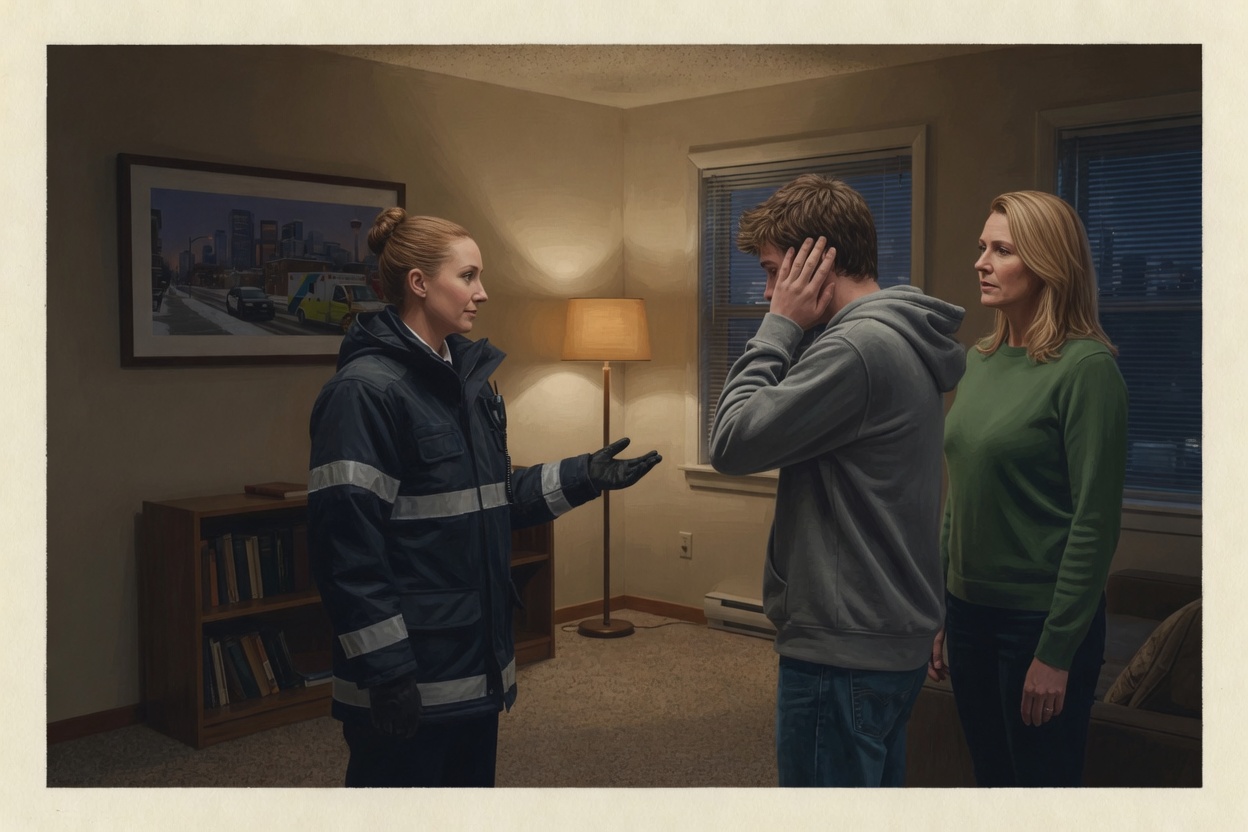
Figure 13. Difference is not non-compliance. Side-on, one voice, sirens off, wait. Hands covering ears is overload, not defiance. Ask the caregiver what helps.
Interactive Below — Recognize → Respond
Check the cues you are observing. The tool tallies them and builds a recommended, accommodation-first response. It is an awareness aid, not a diagnosis — never label someone autistic on scene; simply respond as if difference, not defiance, is driving the behavior.
0/6
No cues marked yet
Mark what you observe. Whatever the count, defaulting to a calm, low-stimulation, plain-language approach is never wrong.
Accommodate
Lower the Stimulation
Kill the siren and strobes if it is safe to. Reduce the number of responders crowding in. Bright light, noise, and many voices can push an autistic person into overload and shutdown.
Accommodate
Give Time to Process
Ask one thing, then wait — processing can take far longer than the silence feels. Repeating or escalating because there was no instant answer makes it worse, not faster.
Accommodate
Plain, Concrete Language
Short, literal sentences. Say “sit on the bench” not “take a seat and relax for me.” Avoid sarcasm, idioms, and abstract commands, which may be taken literally or not parsed at all.
Accommodate
No Sudden Touch
Announce before you approach or touch, and avoid grabbing. Unexpected touch can trigger a defensive reaction that is sensory, not combative — and reads tragically as “resisting.”
Ask the Right Question
If family, a caregiver, or a support worker is present, ask them how this person communicates and what helps — they are the experts on this human. Many autistic people also carry communication cards or wear identifying items. A few seconds of curiosity prevents the worst outcomes. Apply your agency’s policy on accommodations and use of force throughout.
Responder Wellness At Home
§ 12
The trauma you carry does not clock out when the shift does. Occupational stress can follow a responder through the front door — as hypervigilance that never stands down, as numbness that makes it hard to be present with the people you love, as a short fuse, disrupted sleep, or reaching for alcohol to take the edge off. Researchers and responder-support organizations have documented that the strain of the job can spill into home life, and that first-responder families face an elevated risk of relationship and intimate-partner conflict when that strain goes unaddressed.[15]
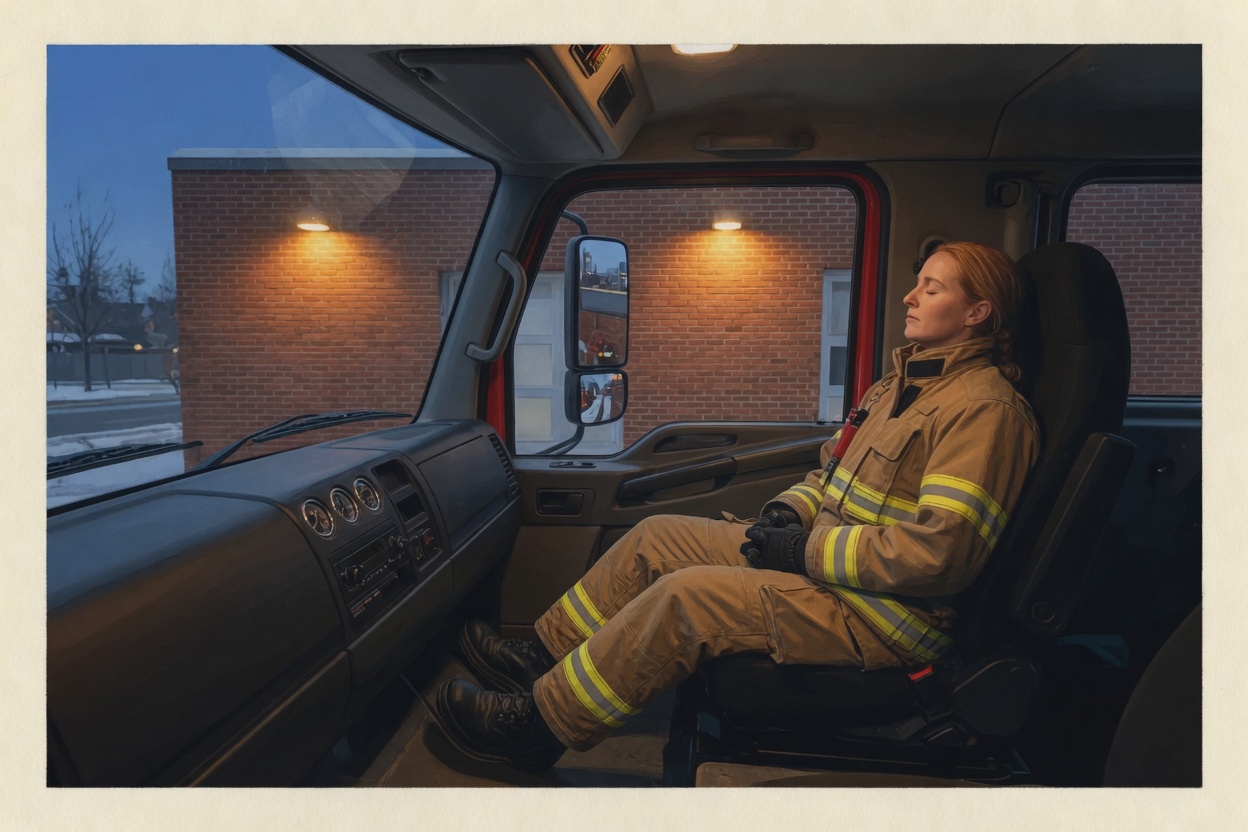
Figure 14. Decompress before the door. Sixty seconds in the cab — feet on the floor, one honest breath — so home is not the first place the night lands.
How We Talk About This — Supportively, Preventively
This section is written for responders and their families, not against them. It is not an accusation, and it does not traffic in sensational numbers. The message is simply this: the spillover is real, it is a known occupational hazard, and — like any hazard — it can be prevented and fixed at the source. Naming it is how families get ahead of it together.
The cause is upstream — untreated occupational stress, exhaustion, and the emotional armor the job requires — so that is where the fix lives. The protective factors are well understood and entirely within reach: early intervention before crisis, confidential peer and family support, a culture that lets responders be human, attention to sleep and alcohol, and screening that catches strain early. The interactive below lets you take stock of which protections are already in place.
Here is the mechanism — and the fix. The WestNet Compartment System keeps three things from overlapping: each call, the shift, and home — with a deliberate reset between calls, a decompression ritual between the shift and the front door, and a real outlet to process the heavy material so it never has to land on the family. Its companion, the WestNet Recalibration System (§13), takes up the opposite motion — not just closing the last call, but opening you correctly to the next. Tap the button to see the boundaries snap into place.
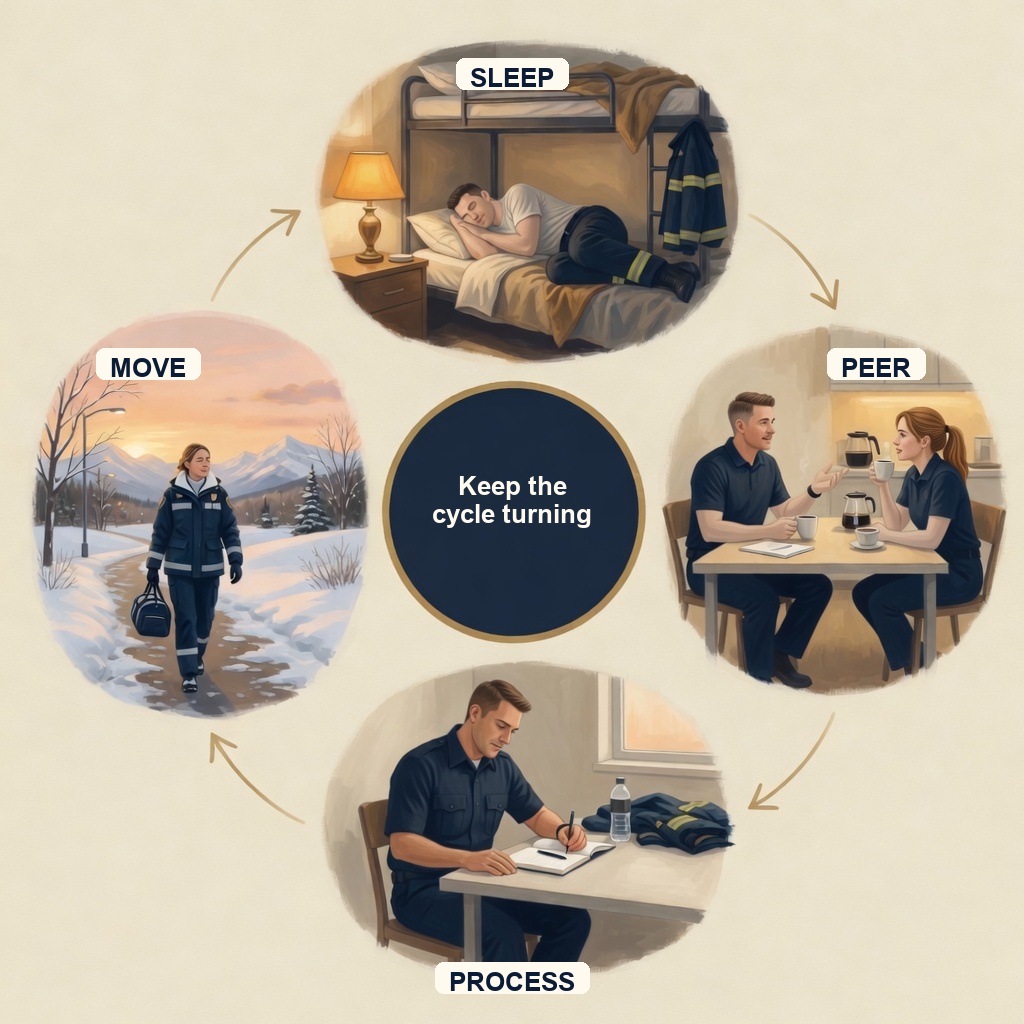
Figure 15. Keep the cycle turning. Sleep, peer talk, processing the call, and moving the body. One broken link and the load compounds.
The WestNet Compartment System
EACH CALLthe scene · the trauma
THE SHIFTuniform · role · duty
HOMEfamily · rest · you
Resetbox-breath · “that one’s done”
Decompressthird space · shift-end ritual
⚠ bleeding over
↓ PROCESS — peers · EAP · clinician
Without boundaries, every call bleeds into the next — and the whole shift bleeds home.
Interactive Self-Check
Home Protective Factors — Inventory
Check the protections currently true for you. This is a private, supportive stock-take — not a test and not a judgment. Every box you can add is a buffer between the job’s stress and the people you come home to. None of these require permission to start.
0/8
Fix · Source
Decompress Before the Door
Build a transition ritual between shift and home — a walk, a workout, ten minutes in the truck. Crossing the threshold still “on” is how the job’s tension lands on the family.
Fix · Source
Include the Family
Confidential family-support and education programs help loved ones understand OSI and hypervigilance. A family that knows the signs becomes part of the early-warning system, not a casualty of it.
Fix · Source
Watch Sleep & Alcohol
Sleep debt and alcohol amplify irritability and blunt emotional control — the exact ingredients of home conflict. Protecting sleep and keeping alcohol in check is direct family safety.
Fix · Source
Intervene Early
The best time to get support is before the crisis, not after. Confidential peer support, EFAP, and counselling exist so a hard stretch never has to become a rupture.
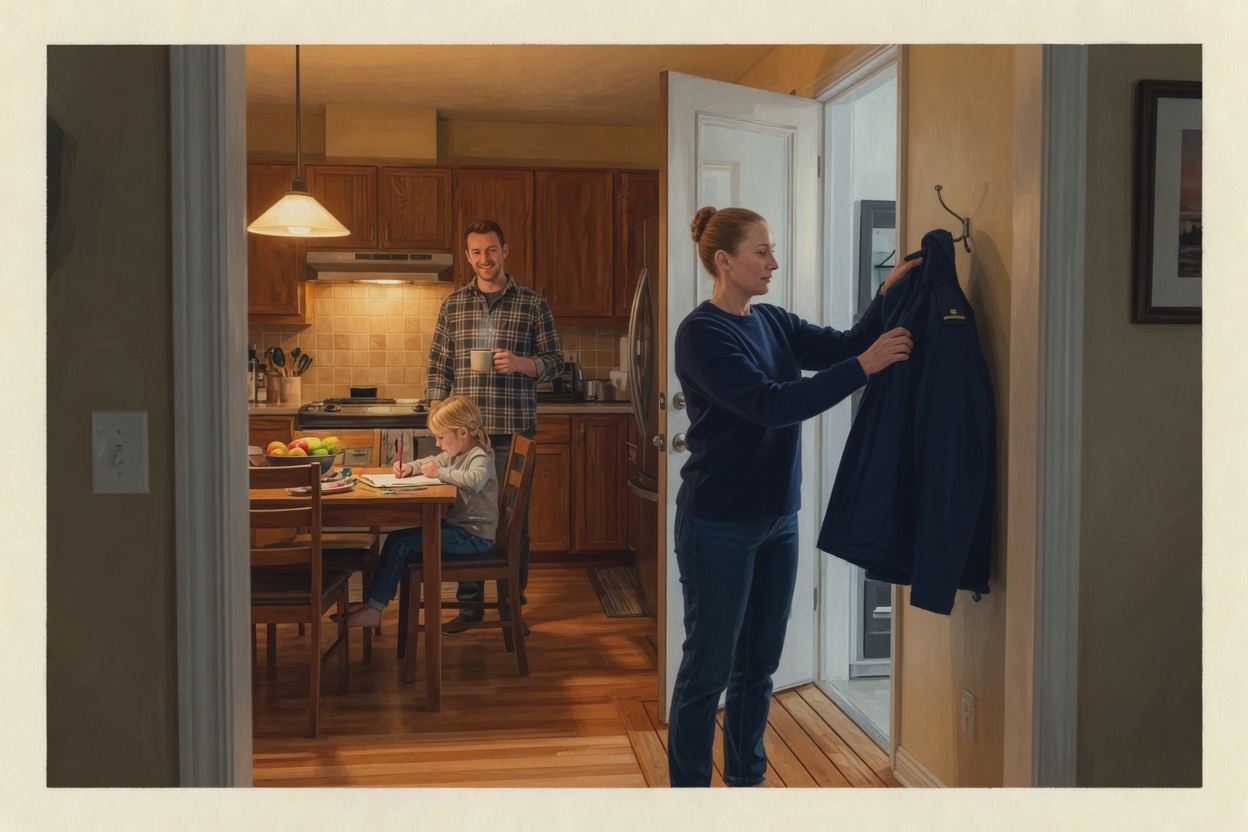
Figure 16. The jacket comes off before you walk into the kitchen. Home stays home when the shift is hung at the door — and the family is part of the early-warning system, not a casualty of it.
A Culture That Lets You Be Human
None of this works if the hall culture treats needing help as failure. Leaders and crews who normalize support, who ask “how’s home?” as readily as “how was the call?”, and who make confidential help easy to reach are protecting families as surely as any tactic. Make humans human again — it starts in the station and reaches all the way home.
The WestNet Recalibration System
§ 13
Going call to call is not only physically relentless — it is a series of hard landings into completely different human environments, one after another, with almost no time between them. A sudden death in a quiet bedroom. Then a fender-bender thick with adrenaline and insurance panic. Then a frightened, non-verbal autistic child who needs the whole world to get smaller and slower. Then a kitchen fire that needs you loud, fast, and certain. Each of those rooms asks for a different version of you — command, comfort, calm, or control — and a shift hands them over in an order nobody would ever design.
Its companion idea in §12 — the WestNet Compartment System — is about closing the last call so it does not bleed into the next one or follow you home. That is necessary, but it is only half of the motion. Compartmentalizing shuts a door; it does not, on its own, open the right one for the room you are about to enter. Carrying the wrong mode through that door is where good responders come unstuck: command-voice and adrenaline in a grieving home read as cold and frightening; the hardness that kept you safe on a violent call lands on a scared child as a threat. That is a clinical error — the wrong presence makes the call go worse — and a personal one, because every mismatch costs something to correct.
Recalibration is the deliberate act of resetting your own state to match the environment in front of you, on purpose, before you engage. It is the root-cause instinct of this whole guide turned on your own nervous system: read what the room actually needs, then become that — rather than running the last room’s script on autopilot. And the cost deserves to be named honestly: a single shift can demand dozens of these forced switches, and they accumulate. The wear is real. Recalibrating well is how you protect both the person in the room and the responder doing the resetting.
The Whole System in One Line
Read the room. Reset yourself. Then knock. The compartment closes the call that is finished; the recalibration opens you, correctly, to the one that is starting. Both, every time — that is how you stay useful to the next stranger and still recognizable to yourself.
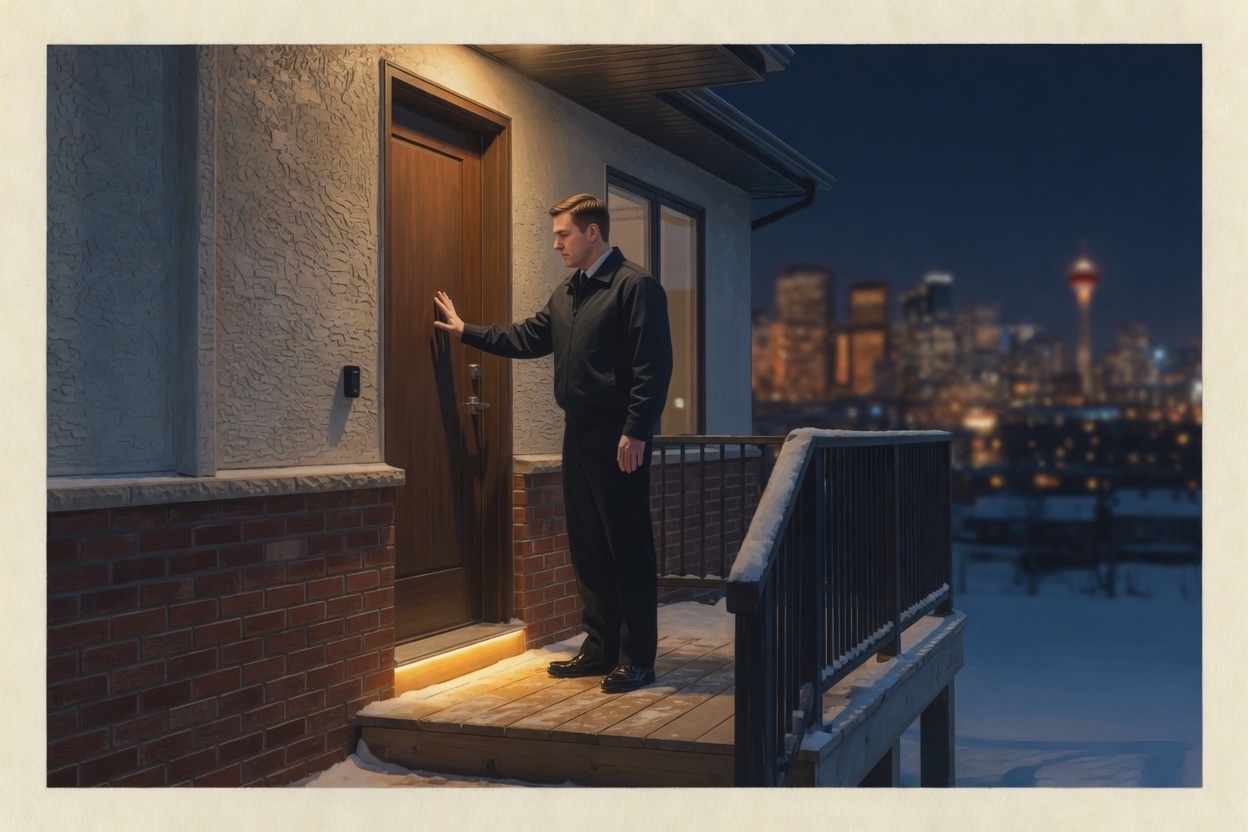
Figure 17. Recalibration is the pause at the door. Close the last call. Read this room. Set your presence. Then knock. Carrying the last room’s adrenaline through this door is a clinical error.
The method is four beats, in order. The first beat is the compartment from §12; the last beat hands its load back to that same system.
Beat I
Close
That one is done. Use the §12 reset — a box-breath, a quiet “that call is finished” — to shut the door on the scene you are leaving so it does not walk into the next room with you.
Beat II
Read
Ask what this environment actually needs before you decide who to be. A death, a wreck, a frightened child, and a fire are four different rooms. Read the room, not just the radio code.
Beat III
Set
Deliberately match your presence to it — command, comfort, calm, or control. Slow your breathing, change your face and voice, choose your first words on purpose. Set yourself before you step in.
Beat IV
Carry the Toll Out
Count the switches; do not swallow them. Each forced recalibration is a small withdrawal, and a shift of them adds up. Carry that load out — to peers, EAP, a clinician — through the §12 system, never home.
How This Pairs With §12
Think of them as two halves of one habit. The Compartment System (§12) keeps each call, the shift, and home from bleeding into one another — it closes. The Recalibration System is what you do in the gap before the next door — it opens you to the right room. Beat I borrows §12’s reset; Beat IV hands §12 back the toll to process. Neither half works well alone.
Recalibrating
Reset between calls before engaging the next one
Read the room and match your presence to it on purpose
Let a grieving home have your quiet, not your adrenaline
Soften deliberately for a frightened or neurodiverse person (§11)
Tally the switches and offload the toll through the §12 system
Carrying the Wrong Mode In
Running the last call’s state on autopilot into a new room
Command voice and urgency into a home that needs comfort
Battle-ready hardness aimed at a scared child or patient
Mistaking “never switching off” for professionalism
Letting the unspent toll of all those switches follow you home
Interactive Below — Read the Room → Set Your Mode
Four environments, back to back, the way a shift actually delivers them. For each room, choose the presence that fits it. This drills the “Read” and “Set” beats — a teaching aid only; your training, your safety, and your agency’s policy always govern the real call.
Read the Room · Scene 1 of 4
For the Service, Not Just the Responder
Recalibration is a skill an individual builds, but the toll it names is a workload an agency owns. A schedule that runs a crew through grief, wreckage, and routine back-to-back-to-back with no recovery between is asking for dozens of forced state-switches a shift — wear that resurfaces later as the burnout in §04 and the home strain in §12. Treat the number of recalibrations a shift demands as real load, and verify staffing, rotation, and recovery practices against your agency’s policy and local protocols.
The Notebook Computer vs the Smartphone
§ 14
Here is a small, practical argument with outsized safety consequences: when you have the choice, do your in-field computing on the vehicle notebook / mobile data terminal (MDT), not the phone in your palm. This is not about rules or generations — it is about how human attention works. A small screen held close does not just show less information; it actively pulls your focus into a narrow cone and away from the scene around you.
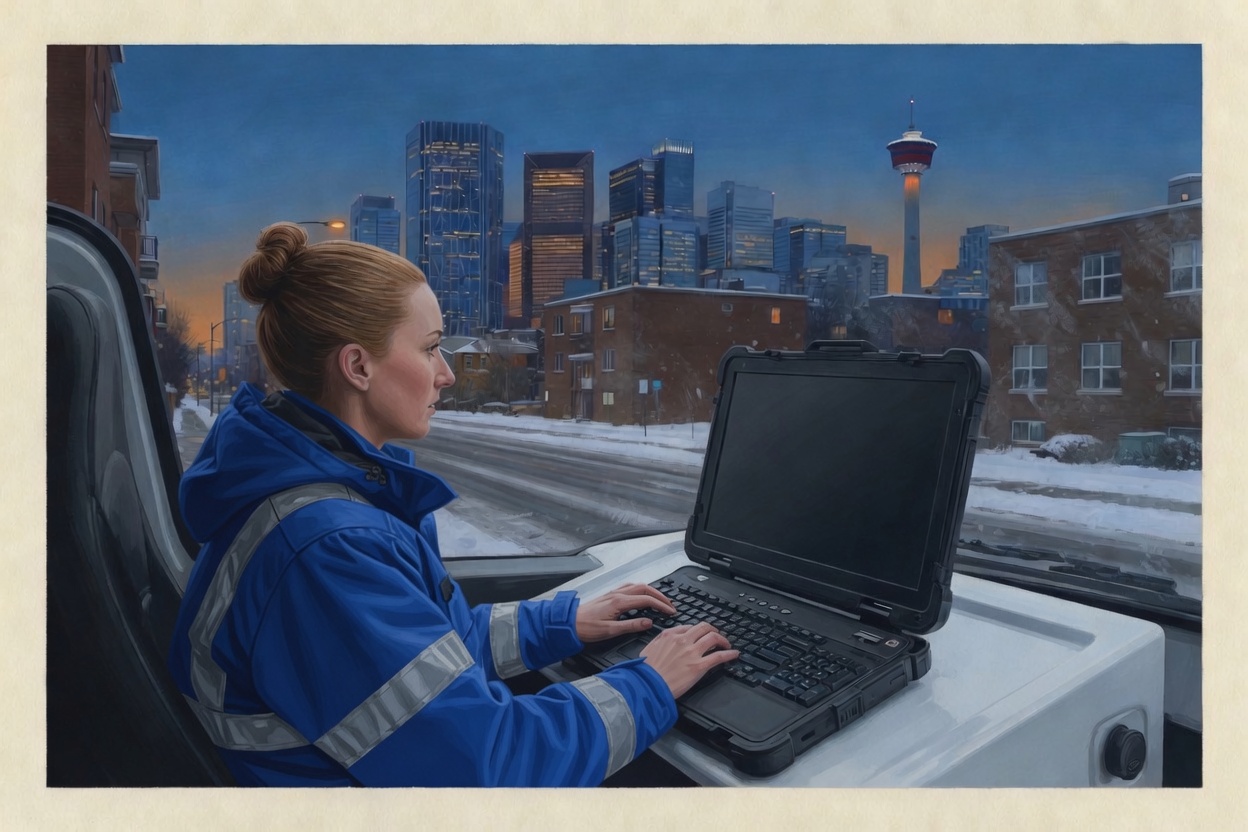
Figure 18. Bigger screen, heads-up mind. The mounted terminal lets you glance and return. The phone in the palm funnels attention into a tunnel. When both are available, the notebook is the default.
The cognitive case rests on a few well-established findings. Attention is a limited resource, and dividing it between a device and the environment measurably degrades performance on both — the basis of every distracted-driving law.[16] Under stress, the visual and attentional field narrows on its own (“tunnel vision”); a tiny screen compounds that narrowing rather than fighting it. Smaller displays also raise cognitive load and lengthen the time your eyes and mind are off the situation, lowering your “heads-up time.”[17] And the larger screen with a real keyboard and proper CAD/records simply produces better, faster, more complete documentation — which is shared situational awareness for everyone who reads it after you.
There is a quieter prerequisite underneath all of this: connectivity. A terminal is only as useful as the link behind it, and a dropped connection at the wrong moment sends a responder right back to the phone in their palm. This is part of why WestNet has, over the years, helped stand up community and municipal WiFi — not as a headline, but as plumbing. The correlation is simple and worth stating plainly: solid coverage paired with a proper in-vehicle terminal lets a responder keep their head up and pull a full record in seconds, where patchy coverage and a small handheld push them back into squinting, thumb-typing, and looking down. Reliable connectivity is not a luxury layered on top of the terminal — it is what lets the terminal do the attention-protecting job described here.
The deeper point is cognitive, not technical. A small screen does not just show less — it narrows the mind to match it. Attention contracts to the device, situational awareness shrinks toward tunnel vision, and the documentation that comes out the other end is thinner, which quietly degrades the shared picture every responder after you depends on. A larger terminal does the opposite: it leaves room for whole-picture thinking — the patient, the traffic, the exits, and the record, held together rather than traded off one for another.
A Point Worth Sitting With
It is a well-documented fact that Steve Jobs sharply limited his own children’s use of the portable devices he helped create.[20] We raise it plainly, not to drop a name: the person closest to these tools still chose, for the people he most wanted to protect, to keep the small screen at arm’s length. The lesson stays narrow and practical — the handheld is a tool with a real cost to attention, and on a scene where attention is safety, the larger screen earns its place as the default.
Interactive Below — The Attention Funnel
A short demonstration of the idea. The same scene is shown two ways: with a wide field of awareness, and through the narrow “funnel” a small handheld screen tends to create. Toggle between them and watch how many of the scene’s cues stay in view. It is an illustration of the principle — not a literal measurement.
Attention & Field of View
Big Screen vs Small Screen
Cues visible in the scene change as your attention narrows. Notice how much disappears when focus funnels to a handheld device.
12
Attention
Wider Screen, Wider Mind
A mounted display lets you glance and return, keeping your head up and the scene in your peripheral vision. The palm-sized screen draws your gaze down into a tunnel.
Cognitive Load
Less Squinting, Less Load
Tiny text and cramped maps force the brain to work harder to extract the same information — load that is stolen from watching the person, the traffic, and the exits.
Heads-Up Time
More Eyes on the World
Faster input on a real keyboard and proper CAD means your eyes spend less total time off the scene. Heads-up time is safety time — for you and everyone present.
Shared Awareness
Better Records, Better Backup
Complete, structured documentation on the MDT becomes shared situational awareness for dispatch, the next unit, and the crew after you. A thumb-typed note rarely does.
The Sensible Version
The phone is not the enemy — it is indispensable for photos, quick lookups, and times the vehicle is far away. The point is a default, not a ban: when both are available, the bigger screen protects your attention and your documentation. Mount it, use it, and keep your head up. Follow your agency’s device, distracted-driving, and records policies.
Building Resilience & Peer Support
§ 15
Resilience in this work is not toughness or the ability to feel nothing — it is the capacity to take a hit, process it, and recover. It is built the way fitness is: with small, repeated, deliberate practices, plus a support system you actually use. The evidence base for peer-support programs, structured decompression, and early help-seeking among public-safety personnel is solid and growing, and the responder organizations that promote them do so because they work.[18]
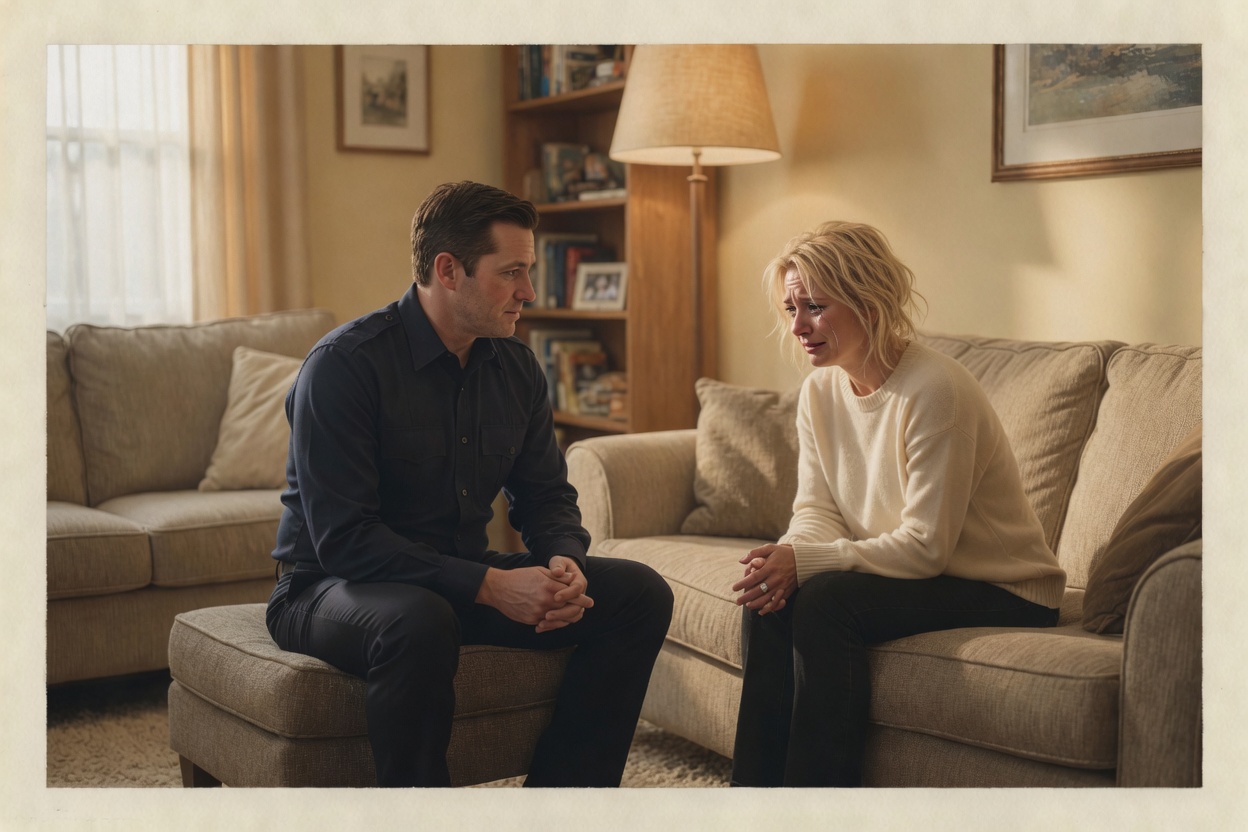
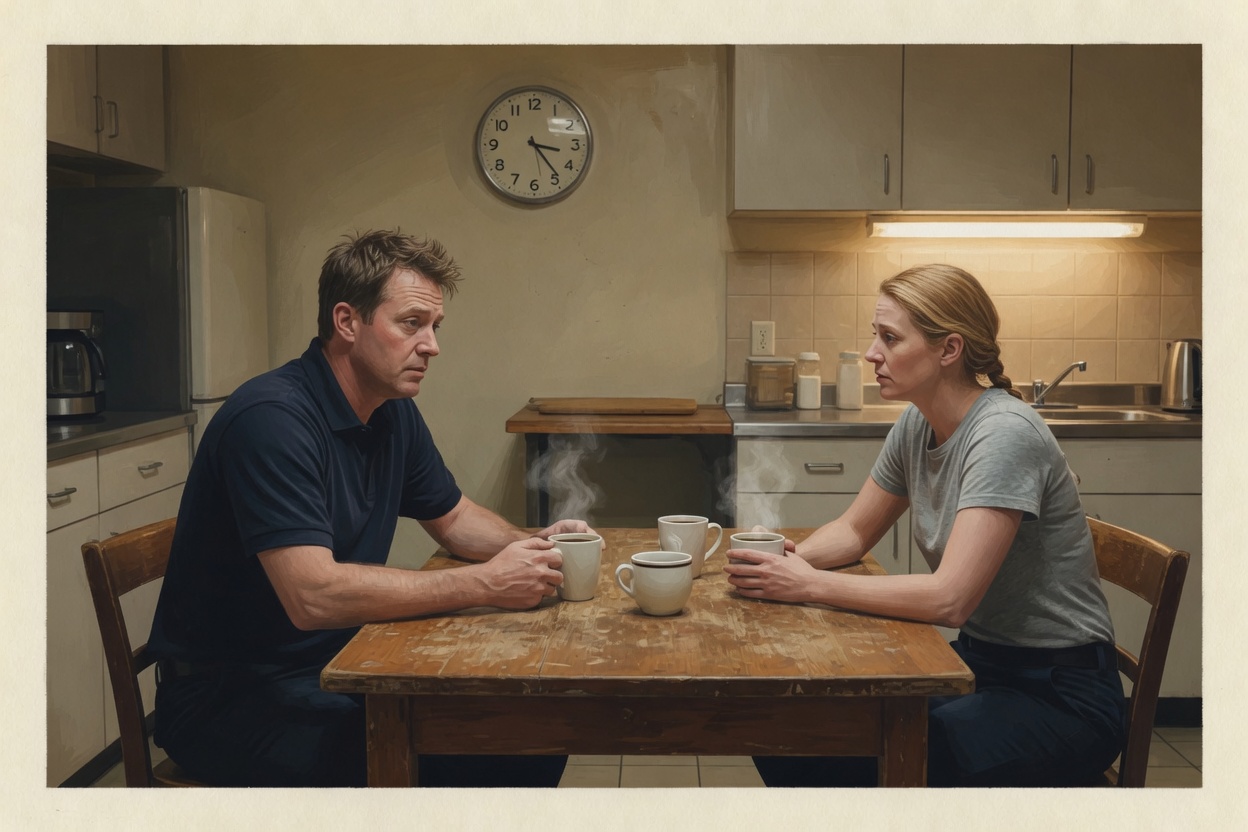
Figure 19. Peer support is force protection. A trusted colleague, a kitchen table, and a culture that lets you say what you saw. Reaching out is the move that keeps you on the job.
Two principles. First, peer support is force protection. A trusted colleague who has been there, a formal peer-support team, and a culture where reaching out is normal catch problems while they are still small. Second, include the family — the people at home are part of your recovery system, and bringing them in (with their consent) multiplies the protection.
Interactive Below — Your Daily Resilience Practices
Check the practices you already do, or commit to. The tool tallies your toolkit — not to grade you, but to make the point that resilience is the sum of small, repeatable habits, each one fully in your control.
Interactive Self-Check
Daily Resilience Toolkit
Each item is a small, evidence-aligned practice that buffers occupational stress. Tap the ones you do or will start. There is no “passing” score — more buffers simply means more resilience in reserve.
0/10
When & How to Get Help
Reach out early — before the crisis, not after. Routes include your agency’s peer-support team, an Employee & Family Assistance Program (EFAP), your family doctor, a psychologist experienced with first responders, and the crisis lines in §16. Asking for help is the move that keeps you on the job, not the one that ends it. If you are ever in immediate danger to yourself, treat it as the emergency it is and use a crisis line or 911 now.
The Root-Cause Field Card
Card
Everything in this guide, distilled to something you can carry. Print the page, cut on the dashed line, and keep it in a vest pocket, a glovebox, or taped inside a locker door — a thirty-second reminder for the calls where there is no time to think.
WestNet First RespondersThe Root-Cause Field Card
1 · OBSERVE — what is in front of you, without the label. Not “an EDP” — a person doing ___.
2 · ASK — “What happened to you?” not “What’s wrong with you?” Find the unmet need under the behavior.
3 · MATCH — fit the response to the cause: pain, withdrawal, trauma, illness, poverty each need a different first move.
Talking to no one, fearfulPsychosis / traumaSpace, one voice, no crowding
Flat, hopeless, giving things awaySuicidalAsk directly, stay, don’t leave alone
Covering ears, avoiding eyesSensory overloadFewer words, kill the lights and siren
Openers: “My name is ___, I’m not here to hurt you.” · “Is it okay if we talk?” · “What would help right now?”
The 90-Second Reset — for you, after the call: Double-inhale through the nose, one long slow exhale — repeat three times. Name five things you can see. One line, out loud or silent: “That call is over. I did my job. I’m here now.”
Treat the person, not the label · medical.westnet.ca/training/first-responders
Why a card at all
Under stress the thinking brain narrows and reaches for habit. A card does not ask you to remember — it puts the method where your eyes already are, so the trained response is the one that fires when it counts.
Crisis Resources — Canada & United States
§ 16
§ 16 — Help is a call away, for the civilian and for you.
Keep these where you and your crew can find them. They are for the people you serve and for you. In both countries, 988 now reaches a suicide-and-crisis line — the 988 Suicide and Crisis Lifeline in the United States and the 988 Suicide Crisis Helpline in Canada (call or text).[19] When there is an immediate threat to life, call 911.
Resource
Reach / Notes
Immediate danger to life
911 — in both Canada and the United States
988 (Canada) — Suicide Crisis Helpline
Call or text 988, 24/7, English & French — for anyone in crisis
988 (United States) — Suicide & Crisis Lifeline
Call or text 988, 24/7; press 1 for the Veterans Crisis Line
Alberta (Calgary Edition)
Health advice line 811 (Health Link); Calgary distress / crisis lines and AHS Addiction & Mental Health services — verify current numbers locally
First-responder-specific support
Your agency peer-support team and EFAP; responder-focused organizations (e.g., national public-safety mental-health programs) — confidential
Opioid / poisoning
Naloxone via provincial/state programs and pharmacies; Poison Control where applicable — follow local protocol
Figure 20. A warm handoff is a resolved call. 911 when life is in danger; 988, 811, peer support, and EFAP for the rest — including you. Confirm current local numbers against your agency list.
Verify Locally
Phone numbers, programs, and the exact names of crisis teams change and differ by jurisdiction. This table is a starting point, not an authority. Confirm the current local numbers against your agency’s resource list and your regional health authority — and keep that list current.
Use Them For Yourself, Too
Responders connect others to these lines constantly and forget they are allowed to call them. You are. If a call is sitting on your chest, if sleep is gone, if the dark thoughts have started — that is exactly what these resources are for. Reaching out is strength, and it is the surest way to stay in this work and go home whole.
Putting It Together — Scenario I
§ 17
§ 17 — Putting it together: one call, from dispatch to handoff.
Real calls do not arrive labeled by chapter. They braid the themes together — an overdose and a frightened bystander, a medical emergency and a communication difference. The two integrated walk-throughs in §17 and §18 show the toolkit working as one. Step through this first scenario stage by stage; each stage names what is happening, why it matters, and the move that fits.
The Call
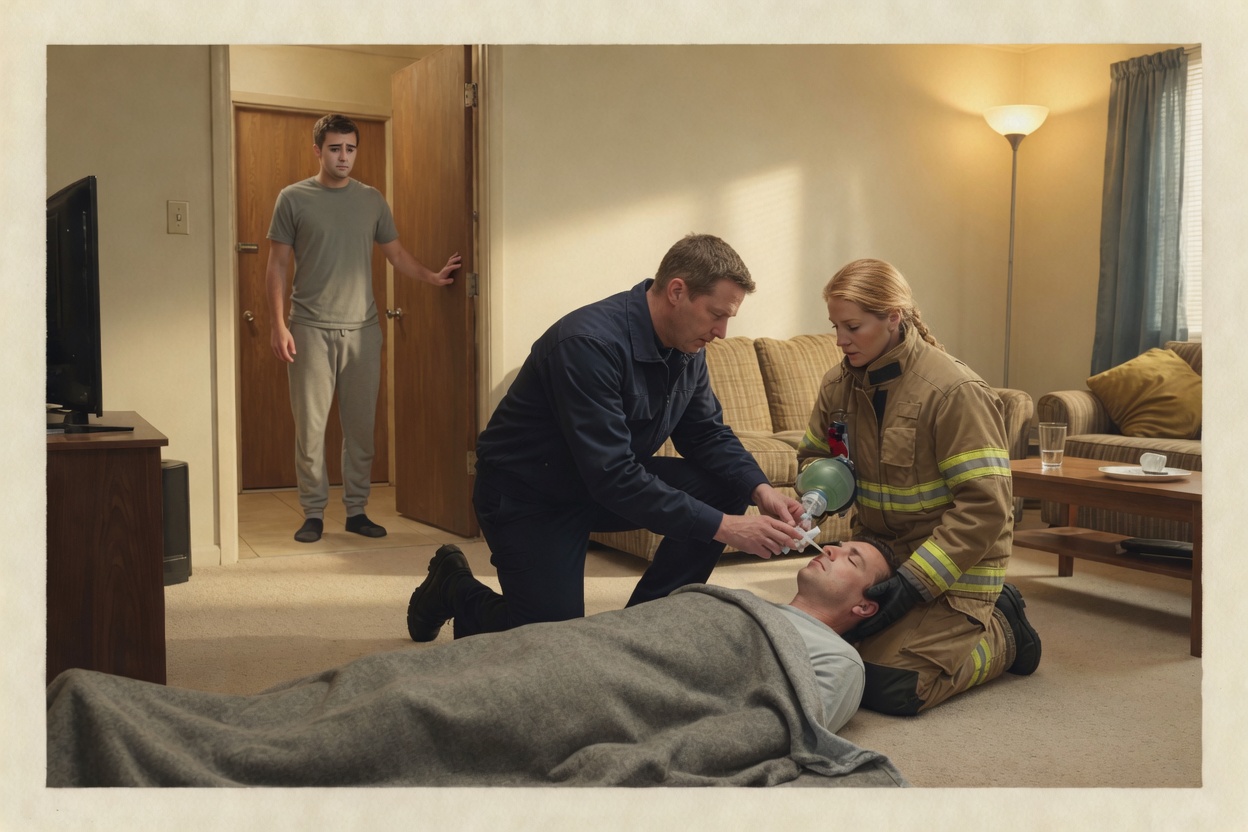
Dispatch: unresponsive male, possible overdose, in an apartment. On arrival a young man is down and barely breathing; a second man — his roommate — is in the corner, rocking, hands over his ears, not answering your questions and repeating “he won’t wake up, he won’t wake up.” Two themes at once: an opioid emergency (§07) and a bystander who is overwhelmed and possibly neurodiverse (§11).
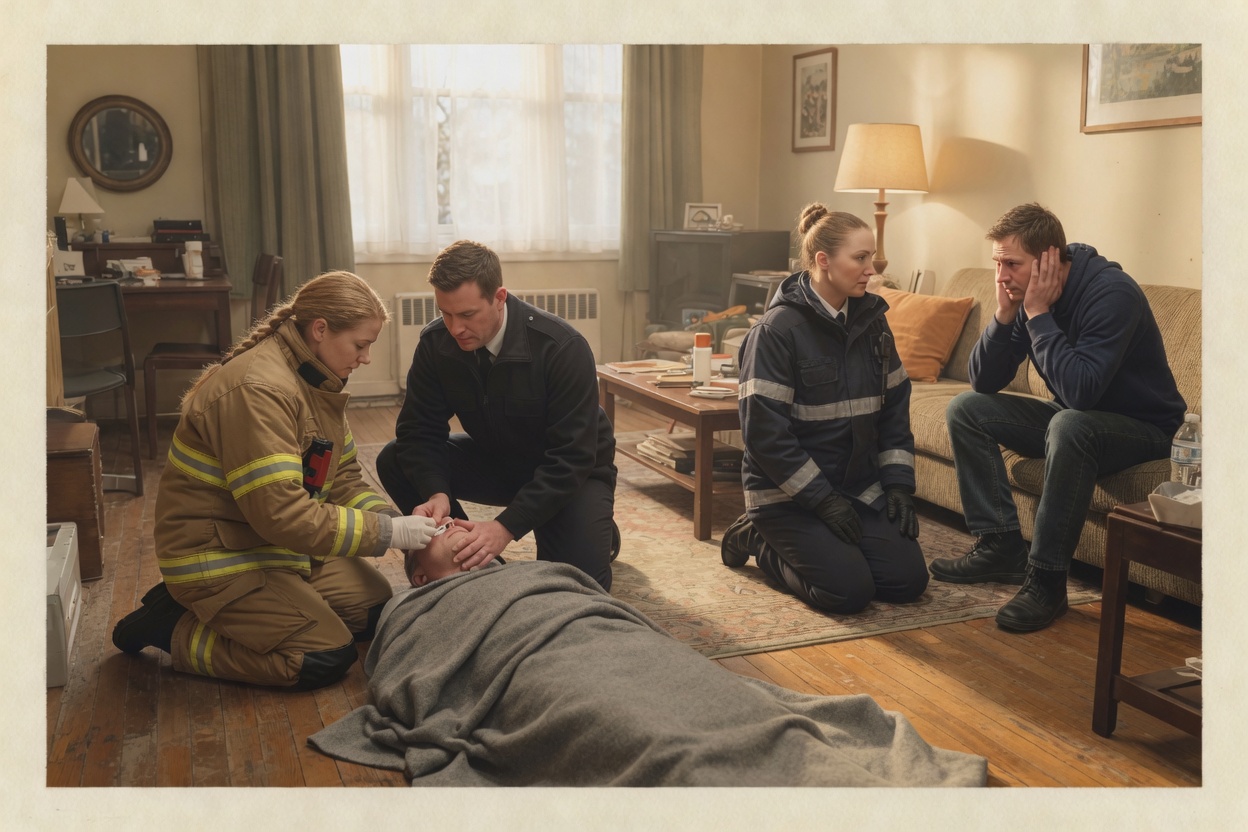
Figure 21. Two jobs, one call. Airway and naloxone on the floor; one quiet voice with the overwhelmed roommate. You do not choose between the patient and the bystander — you split the crew and treat both as humans.
Stage 1 of 5
What’s Happening
Why It Matters
The Move
The Through-Line
Notice that not once did the right move require choosing between the patient and the bystander, or between safety and humanity. Treating the overdose competently and treating the roommate as a human in overload were the same skill set, applied to two people. That is the whole guide in one call: the cause beneath each behavior, met with the right tool and a steady nervous system.
Putting It Together — Scenario II
§ 18
The welfare check is one of the most common — and most quietly dangerous — calls in the post-2020 mix. A request to “check on someone” can resolve in two minutes or escalate into a tragedy, and which way it goes often turns on the responder’s first thirty seconds. This branching scenario lets you make the calls.
The Call
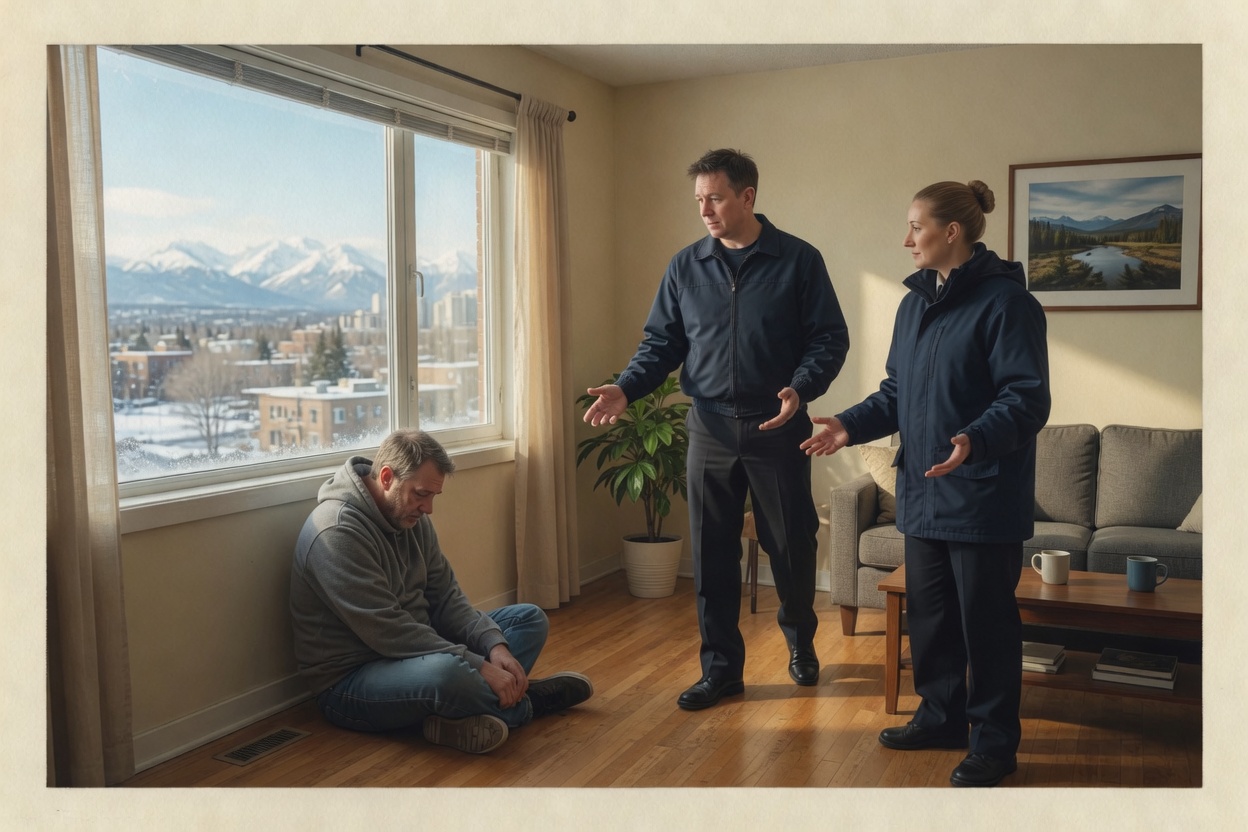
Dispatch: a sister hasn’t reached her brother in three days; he has “a history of depression” and a recent job loss. You arrive at a quiet apartment. The door is unlocked; through it you can see a man sitting on the floor, still, not responding to the door. No weapon is visible. Work it one decision at a time.
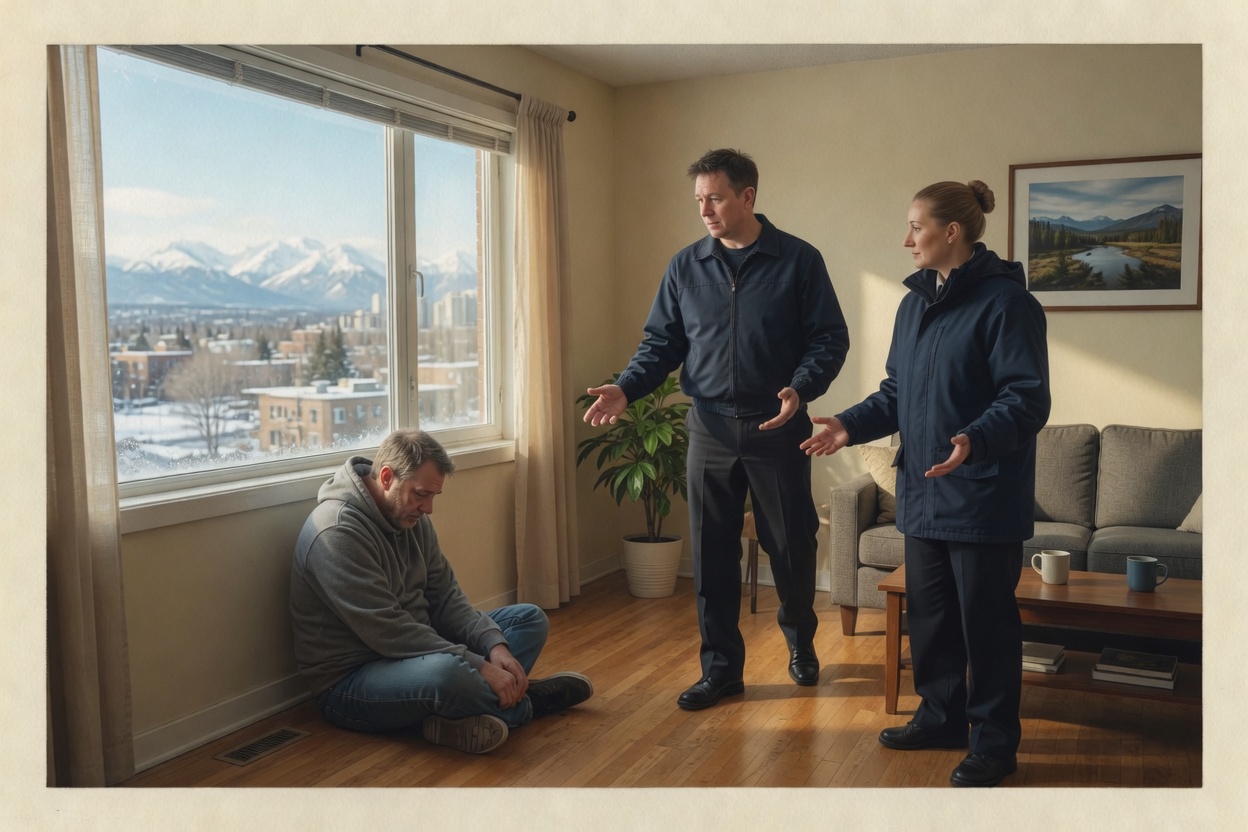
Figure 22. The welfare check turns on the first thirty seconds. Hands visible, low voices, space. A quiet, humane resolution is a success even when “nothing happened.” Verify against your agency’s welfare-check policy.
Welfare Check · Step 1 of 3
Debrief This One
A welfare check that ends with a person alive, connected to crisis support (§16), and treated with dignity is a success even though “nothing happened” — because nothing happened. Quiet, humane resolutions rarely make the news, but they are the bulk of the good this work does. Debrief them anyway: what helped, what you would repeat, what to hand the next crew. And verify every step here against your agency’s welfare-check, apprehension, and mental-health-act policy.
Knowledge Check
§ 19
Eight applied questions drawn from the whole guide. Each gives immediate feedback and an explanation, and your running score tallies at the bottom. This is a self-check to consolidate the material — not a certification exam.
If a Question Stung
Getting one wrong is the point — that is where the learning is. Re-read the linked section, sit with the “why,” and try it again. The goal is not a perfect score; it is a sharper instinct on the next real call.
Competency Self-Check
§ 20
Ten open reflection prompts. There is no answer key — sit with each one, or use them for crew discussion, peer-support sessions, or training debriefs. If you can answer these in your own words, the guide has done its job.
Q1
In your own words, what does “treat the person, not the label” change about how you work a repeat call?
Q2
Name three forces that reshaped the responder call mix after 2020, and one way each changes your approach.
Q3
What is an occupational stress injury, and why is framing it as an injury rather than a weakness important?
Q4
Explain the over-medicalization trap to a colleague without being anti-medicine. What is the “right tool, root cause first” rule?
Q5
A suspected opioid overdose also involves a substance that does not respond to naloxone. What does that change, and what stays the same?
Q6
Define the window of tolerance and explain how co-regulation moves someone back into it.
Q7
Give two phrases that read as gaslighting on a call and a validating alternative for each.
Q8
List four signs that a person may be autistic or in sensory overload, and the accommodation that fits each — and explain why “this is not non-compliance.”
Q9
Name three home protective factors that buffer occupational stress from spilling into family life.
Q10
Make the cognitive case for the vehicle notebook over the handheld in your own words — attention, tunnel vision, heads-up time.
Verify Against Your Agency
These prompts build judgment, not authority. Every operational answer you give must still be checked against your agency’s current policy, your jurisdiction’s law, your medical direction, and scene command. This guide informs your thinking; it does not override your orders.
About the Author — Abdou Traya
§ 21
This guide was written by Abdou Traya, the founder of WestNet N.A. A short note about him is offered here only because it explains the perspective the guide is written from — not as a profile, and not to make any of it about him.
Abdou was born with polydactyly — an extra thumb on his right hand that does not bend — along with macrocephaly, and he is autistic. He states this plainly, as fact rather than as a story about overcoming anything. These are simply part of how he is built. They shaped how he reads systems and patterns — the same instinct that runs through this guide’s root-cause lens — and they gave him early, first-hand experience of being treated as “different,” which is a large part of why a field guide about treating people as people felt worth writing.
A Builder Who Stays Close to the Ground
Abdou tends to build things end to end and stay near the day-to-day of them. A few of the ventures he founded are mentioned below only because each one is part of why this field is familiar terrain — not as a résumé.
Venture
FullVIN.com
A vehicle-history reporting system used by agencies across North America — the kind of background check officers rely on day to day. Building it meant learning, up close, what responders actually need from a record in the field.
Venture
CalgaryFinder.com
A community marketplace that keeps him seeing the city first-hand — the people, the neighbourhoods, and the everyday realities behind the calls this guide describes.
Venture
WestNet Humanitarian Services
The humanitarian arm — a UN Supplier and registered NGO (WHS) — through which much of WestNet’s community and relief work is carried, and a co-publisher of this guide.
Work
Public-Safety Tools
The reporting and field tools described below, built quietly for and alongside first responders rather than marketed at them.
The public-safety thread is not new. During the 2013 Calgary floods, WestNet and Abdou pitched in alongside neighbours and crews simply because the city needed hands. In 2020, during the pandemic, WestNet helped deploy PPE where it was short. None of this was done for recognition; it was done because it needed doing.
Along the way he faced his share of doubt and dismissal from community peers, and he kept serving quietly anyway. Foresight rarely gets thanked in the moment. Before the 2020 shortage made it obvious, WestNet already held a large supply of medical masks and had readied the domain masks.health — and being early like that tends to draw friction rather than thanks. Over the years a number of parties tried to interfere with the work. In 2022 there was an attempt to take WestNet out of his hands — a dispute in which those parties tried to pull the local police service into what was, at heart, a private matter. The police understood him perfectly: they saw the situation for exactly what it was, and a local police service account characterized it plainly as envy. Abdou met it the way this guide keeps asking responders to meet their hardest moments: he kept serving, quietly, and let the work answer. It is the book’s own thread turned inward — treat the person, not the label, even when the label is the one being put on you.
A Note on Reciprocity
Over the years, first responders reached out to WestNet for help more times than anyone bothered to count — and the help was given without keeping score. When attention eventually came his way, it was, fittingly, first responders who quietly returned the kindness. This is written down not as a victory lap but as gratitude: the relationship has always been mutual aid, in both directions, and that is the spirit this guide is offered in.
One story belongs here because it connects directly to §11. Abdou once applied to be a 9-1-1 operator in Calgary and was accepted into testing. Because his right thumb does not bend, he had, over the years, developed an unusually fast way of typing — and in their assessment he set a typing-speed record, at near-100% accuracy. They acknowledged the record, and then were not comfortable hiring him. It is recorded here matter-of-factly, without bitterness: a small, real instance of the neuro non-acceptance this guide asks responders to unlearn — difference read as a reason for “no.” The quiet irony is that he went on to build tools that serve 9-1-1 and the responders who answer it.
Public-Safety Tool
WestNet Crime Reporting Tool (CRT)
Built for local police service 9-1-1 procurement (reference AB-2026-02501), the CRT is a reporting tool designed around the new-age realities and situations this guide describes — cleaner intake, plainer language, and accommodations for how different people actually communicate under stress. It is offered humbly, as a practical contribution to the people who do this work.
The same themes that run through this guide — the changed call mix, neurodiverse interactions, dignity under pressure — shaped the tool’s design. The aim is modest: make the reporting step a little more humane and a little less of an obstacle for everyone on both sides of it.
Why This Bio Is Here At All
This page exists for one reason: to explain the perspective behind the guide. If a person who was repeatedly read as “different” can build tools that serve the very people who serve us, then the guide’s central request is not abstract — it is lived. Treat the person, not the label.
References & Evidence Base
§ 22
The sources below are authoritative and public — peer-reviewed literature, government and public-health agencies, professional bodies, and recognized autism / law-enforcement and responder-wellness guidance. Where this guide describes a trend (opioid harms, call-mix change, responder distress) rather than a fixed figure, that is deliberate: the live data belong to the official trackers linked here, which should be read for current numbers.
WestNet cites primary and official sources so responders can read them and judge for themselves. Consistent with this guide’s integrity standard, we have deliberately avoided inventing precise statistics — especially Calgary-specific overdose, officer-involved, or domestic-violence figures. Those are real and important, but they live on the official dashboards above and change over time. Read them live; cite them honestly.
About WestNet First Responders
§ 23
WestNet First Responders is a professional-education imprint co-published by WestNet Medical Publications and WestNet Humanitarian Services (WHS) — a UN Supplier and registered NGO (www.westnet.ngo). The imprint exists to put root-cause, trauma-informed, pro-community thinking into the hands of EMS, fire, and police across the United States and Canada — the people who carry the post-2020 world on their shoulders every shift.
This is the Calgary Edition of Responding in a Post-2020 World, No. 01 in the series. It grounds the North American picture in Alberta’s real, public programs while keeping every principle portable to any North American jurisdiction.
Detail
Information
Series
WestNet First Responders — No. 01 (Calgary Edition)
Co-Publishers
WestNet Medical Publications • WestNet Humanitarian Services (UN Supplier / NGO)
Audience
EMS, Fire & Police — United States & Canada
Catalog (UPC-A)
731985456673 — “7 31985 45667 3”
Edition
First Edition • Last updated June 2026 • ISBN 9798173554574
Important — Not a Substitute for Policy or Direction
This guide is professional education, not policy, law, or medical direction. It does not replace, override, or supersede your agency’s standard operating procedures, your jurisdiction’s statutes (including mental-health / apprehension law), your service’s medical control and protocols, or the orders of scene command and your supervisors. Clinical and tactical practice vary by region and evolve over time. Wherever this guide describes an action, verify it against your agency’s current policy and your local protocols before you act. When this guide and your agency’s direction differ, your agency’s direction governs.
The Mission, Restated
Treat the person, not the label. Address the cause, not just the symptom. Protect the responder at the source. Make humans human again — on the call, in the station, and at home. If this guide helps even one responder slow a situation down, see the human in front of them, and go home whole, it has done what it was written to do.
Glossary
Ref
Affect labeling
Naming an emotion out loud (“you seem scared”), which measurably lowers the threat response. A core de-escalation move.
Carfentanil
An ultra-potent fentanyl analogue that may appear in the illicit supply; extremely small amounts can be fatal.
Co-regulation
A regulated nervous system settling a dysregulated one through calm tone, slow pace, and steady presence. Your genuine calm is contagious.
Co-response
A model pairing police or EMS with mental-health professionals so crises are met with the right discipline rather than force alone.
EFAP
Employee & Family Assistance Program — confidential counselling and support for a responder and their family.
Harm reduction
Keeping people alive and safer (e.g., naloxone, non-judgmental care) as the first step toward recovery — complementary to, not opposed to, root-cause work.
MDT / notebook
Mobile Data Terminal — the in-vehicle computer. Its larger screen and keyboard protect attention and documentation versus a handheld phone (§14).
Moral injury
The wound of witnessing or being forced into something that violates one’s moral code; shows up as guilt, shame, and lost meaning rather than fear.
Naloxone
An opioid antagonist that reverses opioid overdose. Does not reverse non-opioids (e.g., stimulants, benzodiazepines, xylazine).
Neuroception
The nervous system’s automatic, below-conscious scan for safety or threat — it reads your stance and tone before a word is spoken.
Occupational stress injury (OSI)
Persistent psychological harm (PTSD, depression, anxiety, moral injury) from work-related trauma exposure. An injury, not a weakness.
Polypharmacy
Use of multiple medications whose combined burden and interactions may outweigh their benefit; a documented, often preventable harm (see Module 06).
Root-cause lens
WestNet’s core approach: address the underlying cause — unmet need, trauma, injury — rather than only the visible symptom.
Window of tolerance
The arousal zone where a person can think and cooperate. Above it is fight/flight; below it is freeze/shutdown — in both, reason cannot reach them.
Xylazine
A veterinary sedant increasingly found mixed into the opioid supply; it does not respond to naloxone and complicates overdose care.